|
by Estela Zatania
photos: Estela Zatania y La Cañeta collection
Lo que se han enamorao
el Conquero y el Perché,
el Perché de la Cañeta
y el Conquero de José |
[El Conquero de Huelva
and el Perchel de Málaga
are enthralled and in love
with Cañeta and José] |
This
little verse appears on a framed poster from the nineteen-seventies
that hangs in the living room of flamenco singer José
Salazar, winner of two prizes at the first Córdoba
contest in 1956, husband and artistic companion for
nearly a half-century of Teresa Sánchez Campos,
la Cañeta de Málaga as she is known to
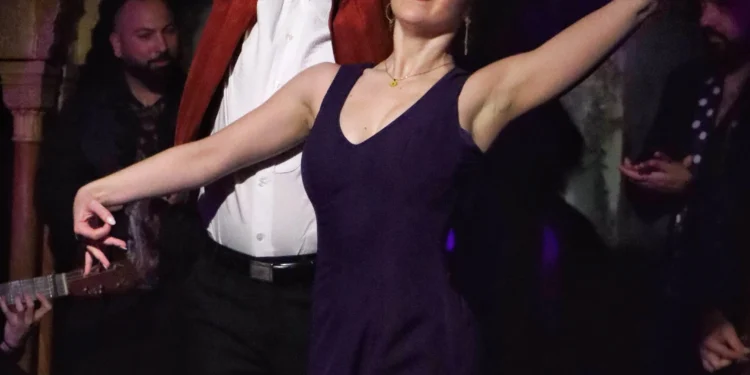
flamenco fans. The lady is an inspired, instinctive,
explosive, authentic singer and dancer, a “festera”
in the noblest sense of the word.
With a professional history that spans decades it’s
nearly impossible to name any major flamenco artist
with whom she hasn’t shared a stage. Cañeta
worked her way through the heyday of tablaos, from beginning
to end, taking advantage of the experience to invent
a unique and unmistakable artistic persona, far removed
from the gentle sweetness we associate with Málaga
flamenco, neither is it Jerez or Sevilla style, but
pure “Cañeta”, a savory mix of voice
and dance all passed through the filter of her own personal
vision in each performance, spiced with colorful dresses,
flowers, ruffles and polkadots, the very antithesis
of the currect glacial aesthetic of black upon black.
Exhibiting boundless energy on stage, the years appear
to slough away as communication is established with
her audience.
| |
|
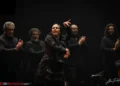
| Cañeta
de Málaga |
Cañeta de Málaga |
This is a woman who has seen and experienced the best
of flamenco and knows how to deliver her own personal
vision free of additives. She doesn’t know what
“fusion” means because she is fusion herself,
cultivating a festive repertoire with careful attention
to the verses, some old classics and other original
ones often based on the most current flamenco artists
such as Capullo or Remedios, even Spanish pop singer
Bisbal, old traditional songs, folklore or detergent
jingles. She is the daughter of La Pirula, creator of
the famous Málaga tangos popularized by la Repompa,
but she is proud of having her own unique personality.
In 2000 la Cañeta was named “Cantaora
del Año “ [singer of the year] by the Mesón
El Chinitas and in 2005 she was awarded the Medalla
de Honor del Ateneo de Málaga. The day after
the inauguration of the first edition of the Málaga
en Flamenco festival we had a long conversation at her
home in Marbella. She had plenty to say, it was hardly
necessary to ask any questions so I let her speak...
ARTISTIC IDENTITY
I go it alone onstage, it’s not a “fin
de fiesta” and head for the door. I defend my
name and my roots. Where am I going to work? How am
I going to fit in with a star’s show? Not for
all the money in the world, I just don’t want
it. I prefer my own three or four things and that’s
what makes me happy, I don’t want problems. I
communicate with audiences on my own terms, we can’t
all be the same person, everyone can’t be Lola
Flores or Carmen Amaya, each artist has something special
to offer, and that identity has to be respected, because
I tell you, I’m not one of these ones who’s
listening to records all day, I’m always, improvising,
improvising, improvising, and that’s not easy!
Not everyone realizes it, they don’t get it or
know how to appreciate it, but if you don’t let
me improvise, what kind of artist am I? Am I supposed
to follow your script? Twenty minutes, a half hour?
No, I just can’t, this isn’t what it’s
about my dear. Go and do it yourself if you think it’s
so easy! These people nowadays spend their lives in
the rehearsal studio, all of them, Canales, Cortés,
Sara Baras, they’re all prefabricated! I get up
there on stage and “here I am folks!”, no
one does that any more nowadays, and on top of everything,
they don’t give you an inch, but thank God audiences
always react to what I do, it never fails...the people
really love what I do and that’s all that matters.
| |
|
|
|
Cañeta,
José Salazar |
Cañeta, José
Salazar |
Cañeta, José
Salazar |
With Málaga en Flamenco now I’ve got five
shows with el Pipa, in Vélez-Málaga, Estepona,
Ronda, Torremolinos, then back to Málaga with
Matilde Coral and Chano, the whole province of Málaga,
then in each province an artist from that province,
in Seville, José de la Tomasa, in Jerez, Capullo,
etc...
HER MOTHER ‘LA PIRULA’’
 |
La Pirula |
No one knows the first thing about my mother…
I can tell you what little I remember, because I was
very small, she died young and each year on the anniversary
of her death Gonzalo Rojo writes an article about her.
When mamá died I was only ten or eleven, so I
didn’t see much of her dancing and singing, but
of course, I knew she was good because they always called
her for the gypsy fiestas in Málaga. I never
went with her, just once when we went to Madrid to present
a recording with Antonio el de la Calzá, the
great fandango singer we used to have, so we went to
Madrid and she caused a sensation, with just a few cantes
she did, short and sweet but outstanding, and that’s
how she got by, always a very independent woman..
 |
El Piyayo, La Pirula,
periodista |
My grandmother told me how La Niña de los Peines
took her in the group after seeing her in Málaga,
she hired my mother who was just a delight to hear and
watch, a portrait of flamenco art, and a great voice,
not so rough and strong like mine, different, more tranquil,
more “Pastora”...she wasn’t me and
I’m not her, if you know what I mean. So what
I have of my mother is basically what I’ve learned
through others, but they’ve got it so overworked
I prefer to do my own things although I do some of her
material, but they do it so much it’s burnt out
because all they know is the tangos of La Pirula, and
the only letras they do for bulerías are of La
Pirula. The way it goes is this, la Repompa had a big
sister who’s still alive, Paquita, and she did
hear my mother and picked up the repertoire. La Repompa,
the famous one who died so early, was younger than me
and could never have heard my mother although she knew
her, so the younger one got the tangos from the record
her older sister made in Madrid. I’ve also got
a brother who lives in Barcelona and is delightful “por
fiesta”, Tiriri de Málaga is another relative
and my father was El Cañeto, but I couldn’t
tell you what the nickname means.
“My internal
clock tells me when to start and when to stop, I need
my air-space, you’re up there creating, seeking
out each little thing...that’s why you never see
me the same twice”
BACKGROUND
When I was in Madrid it was Repompa who spoke about
me to Pastora Imperio at Corral de la Morería,
that’s how I got in, because Pastora Imperio had
known my mother and when she hired Repompa she asked:
“Didn’t Pirula have a daughter?” “Yes
Pastora, she sings and dances quite well and she’s
down there in Málaga”. “Well call
her”. And I went to Madrid in ‘56 or ’57
when the Corral had just opened, the grand opening was
with Pastora Imperio dancing , Beni de Cádiz
and Porrina...they each sang different alegrías
for her, and the guitarist Doblones de Cádiz.
There I was with all those people and I thought “Wow!
this is great, this is for me!”. And little by
little I got completely hooked. I was surrounded by
the best artists. From Corral de la Morería I
went to the Duende which was owned and run by Gitanillo
de Triana and Pastora Imperio.
I never studied with anyone and they used to say “hey,
you have to learn how to find the tones”, but
I learned to sing in the cuadro, from the “jaleo”,
the cheering and group singing. It was my husband who
got me into singing, because I started out dancing and
Farruco told me “there’s no one with footwork
like yours”, but I wasn’t bad singing, and
there weren’t all these women like there are today
who sing and dance...there was La Bronce de La Línea
and Adela la Chaqueta, no one else.
| |
|
|
| con Fosforito |
con Pastora Imperio |
con Pepito Vargas |
So there I was will all those tremendous artists…fourteen
tablaos there were in Madrid, and all of them full every
night, working at full steam, there was enormous interest
in flamenco and first-rate artists…la Paquera,
Farruco, ‘Grabiela’ Ortega, Rafael Ortega
who was Manzanita’s father, Carmen Casarrubio,
Bambino, el Montoyita, Pedro Montoya, Antonio Mairena,
Terremoto, los Morao a la guitarra, el Chano, el Chocolate,
Sernita, el Sordera de Jerez, Matilde Coral, Rafael
el Negro, great ambience, that’s what I call roots!
Not like today where everyone just wants to get to the
top, there’s no comaraderie, just envy... That’s
where Rocío Jurado started out in case you’re
interested, she was singing things of Concha Piquer,
also her alegrías, tientos... The solo artists
were getting 1,250 pesetas a day, a king’s ransom!,
and they had us all make recordings.
I learned a lot in the tablaos. I was twenty years
old when I got to Madrid and stayed for twenty years.
I was also in Zambra with all the greats that were there
during the heyday: Bernarda, Fernanda, la Perla de Cádiz,
el Culata, Pericón, Almadén, Manolo Vargas,
Jarrito, Varea and dancers Paco Laberinto and Rosita
Durán, they were all there back then.
I was also in another important tablao, Villarosa,
with Chaqueta, Felipe de Triana, Luis el Compadre, Chaleco,
the best of the best all making their living, traveling
abroad. You didn’t go to Japan back then, but
I traveled to the rest of the world from one end to
the other. We went to France with Curro Vélez,
to Santa Fe, New Mexico with Vicente Romero, to the
New York World’s Fair with Manuela Vargas and
José Salazar, we met in Madrid and were already
married then. He’d been with Concha Piquer, always
sang with the best, from that group Enrique Montoya
and Rafael Farina became big stars.
In Madrid I ended up going with Antonio Gades, he was
putting a show together and wanted someone who could
sing and dance, and he took José as cantaor...Bogotá,
the whole country of Ecuador, Buenos Aires, New York,
México at the Rincón de Goya, Japan...
Jarrito was the first to go to Japan, and soon afterwards
we went, around 1968, today there’s twenty times
more interest, but even back then it was happening,
and they knew Mairena’s complete anthology, and
all the malagueñas and cartageneras. We were
there with la Tati, Duque...we were in Japan for one
year and made three records while we were there, then
we toured Germany with La Singla and made another record,
with Juan Maya ‘Marote’ and Antonio Arenas.
RECORDING
The first recording I made was with guitarist Paco
Aguilera, the “Miguelito” song, long before
it became such a big hit when that group of veteran
artists were doing it, I learned it from a Cuban guy.
On the record my husband José sings some alegrías,
fandangos de Huelva, each one did something different,
Repompa is also on the record...it was Paco Aguilera
who organized everything, that’s how it used to
work, through the guitarists, the Colombia record company.
I went on to record with Fernanda and Bernarda, Antonio
Arenas was doing a lot of that then, and I made a solo
record with the Zafiro record company. José was
really at the top in those days, a well-rounded traditional
singer who knew his job, but times change and what I
do is different from him, his vocal chords are shot
from singing so flamenco and so strong, but my thing
is different, not only from what he does but from everyone,
it’s something God willed, not better or worse
than anyone else, just something that’s inside
of me and has to come out, and nothing you can do about
it. What I do wasn’t learned in Málaga
because there’s none of this in Málaga
as you know....ladies and gentlemen, I’m no backup
artist for a short solo spot...my internal clock tells
me when to start and when to stop, I need my air-space,
you’re up there creating, seeking out each little
thing, that’s why you never see me the same twice,
you know that better than anyone.
THEIR OWN TABLAO
We had two tablaos in Marbella. We left Madrid and
went to Marbella because the tablaos were washed up,
many of them closed and the ones that remained were
for the tourists, this was at the beginning of the seventies,
it just wasn’t worthwhile any more. The first
tablao we had was called Los Corrales and it was always
full of people: ”...meet me Cañeta’s
place!”, and Cañeta Cañeta, no one
ever called it “Corrales”, but it was really
nice, we did it up like a corral... The king’s
father, Don Juan, came by four or five times and José
had to stand guard in the doorway so no one would enter
because the show was just for him. All the important
people passed through, film directors, actors, politicians,
bankers... The only regular performers were myself and
José and a guitarist, people were always coming
and going. Tomatito’s father brought him when
he was just a boy, I brought Nano de Jerez... But we
had to close because it was a ground floor in Puerto
Banús, it’s not like today, there were
just a couple of private houses and they couldn’t
take the hell-raising, we used to finish up at six or
seven in the morning, it was something else! They were
on our backs all the time, it was impossible, the police
came and threatened to close the place down so we had
to leave.
| |
|
|
| José
Salazar y La Cañeta con Camarón |
con Rocío Jurado |
con Burt Lancaster |
So we set up another place out in the country and started
all over again, and again it was a smashing success
because José Banus used to send people there...Liza
Minelli held a press conference there, so you can imagine
what my place was like. We had a fantastic group of
artists.... Anzonini, la Gallina, two sisters from Cádiz
who were a delight, Nano de Jerez, el Extremeño,
guitarist Rafael Alarcón. Then Lola Flores saw
how successful we were and went to speak to Pilar Banús.
She opened a tablao not far from mine and hired the
most important artists of the moment, but she couldn’t
compete with us because our place was very flamenco.
She set hers up as a standard tablao show, but our format
was more free-wheeling, people used to participate,
one night Camarón and Paco de Lucía came
by...they sang, played, danced, and at 2 in the afternoon
the following day they were still there. People would
come from jerez, from Tío Paula... It was a unique
era, we made plenty of money, but then that too went
bad, everything went downhill in Marbella and it wasn’t
a fraction of what it had been. Then there was the tablao
Pansequito as it was called, also nearby...they hired
Camarón and Pansequito...but that couldn’t
survive either...
THE CURRENT FLAMENCO SCENE
Nowadays there are things that aren’t bad, but
mostly a lot of shouting with nothing behind it, I don’t
know where we’re going, but let me tell you ladies
and gentlemen, this is disappearing. Then if you dare
to say so, they call you old-fashioned, but flamenco
has no age, art has no birthdays, look, people always
connect with what I do, so where’s the age? Thank
God I have my audience, people know what I do and they
like it. If I were born into these times I don’t
know what I’d be doing, or even if I’d be
a performer, I suppose I would, but in something other
than flamenco...everything is changed...
|
|