|
Artefyl brings you the self-portrait of:

“I’m very proud that
Spain has awarded me the honor of the Cruz of Isabel la
Católica”
by Manuel Moraga
She is the most important embassador of Spanish
and flamenco dance in the United States. She knew how to
learn and how to teach. Over thirty years bringing our most
genuine culture to the stages of all America and Europe
have made her worthy of one of the most important awards
the Spanish government can present. This is María
Benitez’ self-portrait..
Round-trip ticket: the first leg of the journey
I was born in Taos, a little town in the north of New Mexico.
Having Spanish roots and with an interest in Spanish dance,
I began to study with a teacher who had studied with the
famous Cansino family (of Rita Hayworth). I was just a young
girl then, but later, when I was a little older, I decided
to go to Spain to study more intensely and I looked for
the best teachers at Amor de Dios: Victoria Eugenia for
classic (one of the directors of the Ballet Nacional long
ago), Pedro Azorín for jota, Mercedes and Albano
for flamenco, and years later I studied a great deal with
Ciro in Madrid. Also Mario Maya who set some dances and
a choreography for our company. I spent many years in Spain
and worked as soloist with Paquita Rico’s company
as well as with María Rosa. With this company my
husband and I returned to the US and settled here: in those
days there was little flamenco and lots of work.

Good sources
In Los Angeles I was with Carmen Amaya, Luisa Triana and
her father Antonio Triana, her uncle Maestro Matos and many
more people than I could possibly name. I heard and met
guitarists like Sabicas, Mario Escudero, Paco de Lucía,
Chuscales, Andrés Heredia, Carlos Sánchez
and Manolo Sanlúcar. And also singers like El Niño
de las Cabezas (Miguel Gálvez), Domingo Alvarado,
Silverio Heredia, El Falo, El Chocolate, Enrique Morente
and many others.
“If you want to make a
career out of Spanish dance, including flamenco, you have
to be as versatile as possible”
First stops on the trip
My main learning was with Victoria Eugenia who gave a strong
foundation in classic: arms, castanets, placement, body
movement to combine all the rest. In my opinion, most foreigners
(especially Americans, because that’s the group I
know best) jump right into flamenco without having a preparation
in Spanish dance. I think if you want to make a career out
of Spanish dance, including flamenco, you have to be as
versatile as possible. For me, playing castanets is an integral
part of Spanish dance. If you get a job in the opera “Carmen”
(I’ve done a lot of opera) and the director wants
castanets but the dancer can’t play them, that’s
one lost job. The dancer doesn’t need to use castanets
in his or her own dances, but must know how to play them.
After Victoria Eugenia (Betty), I spent a long time with
Mercedes and Albano who are of the flamenco style, but also
have great knowledge of classic dance.
“I admire something well-rehearsed,
but at times I miss the risk-taking”
Discipline and inspiration
My dance is closely related to my physical appearance and
in a certain sense is a somewhat savage: I’m not a
completely rigid dancer. I very much admire something well-rehearsed,
but at times I miss the risk-taking, I mean like throwing
yourself into a movement without knowing what’s going
to happen. It’s also very dangerous! By doing that,
I’ve discovered some very interesting things, but
I’ve also made a lot of mistakes. I like the surprise
element, and not only in dance, also in music in general.
I don’t want to know what’s coming up.
The sources keep flowing
As a result of this dedication to dance, I founded the Instituto
del Arte Español, a non-profit organization whose
objective is to give continuity to the new generation interested
in this art-form and perpetuate it in this part of the world
where there is great interest in all things Spanish. I feel
fulfilled when the students show discipline, energy and
concentration for learning the first steps, the exercises
which are so important. When they have it, then they can
move up to the next level, which is always more difficult.
You have to consider that Spaniards are born with flamenco
and have it around them all the time. Not here. That’s
why we have to begin with the first steps, that’s
the foundation.
“Being a member
of this company, the pride they take in their culture is
obvious”
The seed
At the Institute I have a group of young people (10-18 years
old) called Próxima Generación de Flamenco
and they perform at schools, community events, private parties,
as well as our Gala and other occasions that arise. Although
most of them won’t go professional, this experience
teaches them important concepts like cooperation, the quest
for excellence and discipline. And of course, they learn
how to study, to rehearse dances, to prepare for a show,
to learn the rhythms, to dance with guitar, etc. Some of
these dancers teach children at the Institute, and others
give classes in small towns near Santa Fe. I like it that
most of them are Hispanic and being a member of this company,
the pride they take in their culture is obvious. When they
start giving classes, they see the economic compensation
that comes after having devoted their time, energy and resources
to studying this art.
In summer when we do the workshop we get between 200 and
250 students from all parts of the country and from other
countries as well. Some teachers we’ve brought are
Ciro, Mario Maya, Javier Latorre, Joaquín Ruiz, Domingo
Ortega, Luis Ortega, Ángel Muñoz, Antonio
Granjero, Rafaela Carrasco, Alejandro Granados, etc. When
the course is over, there’s a Student Recital in the
theater where everyone participates, from the children to
the professionals, doing what they learned during the course
including dance, guitar and cante. It’s a tremendously
popular event and always fills the theater.
“It’s hard when
the greatest challenge is getting to the theater on time
instead of concentrating and preparing what has to be down
in the show”

The long haul
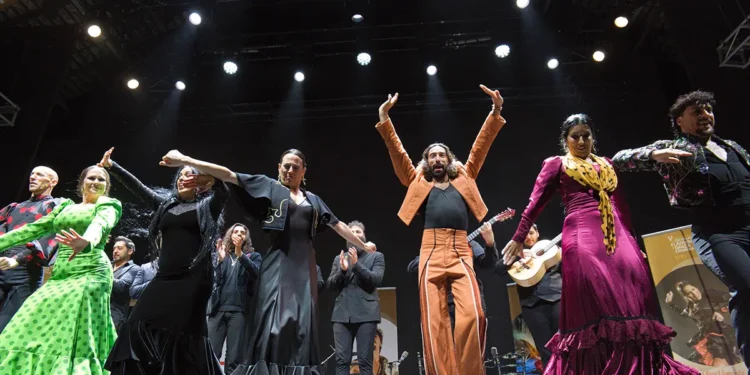
My company has been going strong for 33 years and some of
the best artists of our time have performed in it. I had the
good fortune to bring choreographers from Spain to mount works
and ballets that we eventually took throughout the country
including many performances at the Joyce Theater in New York.
We’ve had people like Ciro (El Muro), Joaquí¬n
Ruiz (Aires de Silencio), Mario Maya (Flamencos de la Trina
and other works by Hector Zaraspe), José Greco (he
did two tours with us), José Molina, Luis and Juan
Ortega, Antonio Granjero, Ángel Muñoz, La Tania,
Adela Clara, Roberto Lorca, Manolo Rivera, Orlando Romero,
Rosita Segovia, Eduardo Montero, Alejandro Granados, Victorio
Korjhan and many others.
Round-trip ticket: the return
After more than 30 years traveling around the US, Canada
and Europe, I’m a little tired of so much traveling.
It’s hard when the greatest challenge is getting to
the theater on time instead of concentrating and preparing
what has to be down in the show. So much touring burns you
out. But this summer, without a doubt, I’ve set myself
a new challenge. I’ve spent two seasons without dancing
in order to manage the organization’s office, but
during this time I’ve learned that the little time
I have, I want to give it to what I’ve been doing
all these years, and not to office administration, there’s
plenty of time for that! I’ve decided I want to return
to the stage with a completely different show that’s
never been done. It’s going to be like a retrospective
of my long career combining film, video, photos, etc. A
retrospectivce not only of me, but also of the many great
artists who have passed through my company.
“To continue to give opportunities
to artists to create and present original works of high
quality, provocative, but always respectful of tradition”
The best of company
And certainly, I cannot forget to mention the most important
person in all this, my husband Cecilio Benítez, who
has been the moving force, always encouraging me in my career.
I wouldn’t be where I am had it not been for him,
his support, his tireless work and keen vision. So it’s
a big project which is going to incorporate everything I
said, combined with dance and live music. But since it all
has to do with cinema, it’s very expensive, now I
have to seek the funding to carry it out...another great
challenge!
The pay-off
I’m very proud that Spain has awarded me the honor
of the Cruz of Isabel la Católica for all the years
I’ve devoted to this art. I’ve very motivated.
Dreams that are possible
My is to see the Instituto del Arte Español continue
to move forward with economic support, with the collaboration
of the general public and of the large foundations that
have power and means. If we had this, we could continue
– at a higher level – to give opportunities
to artists to create and present original works of high
quality, provocative, but always respectful of tradition.
These artists will take the voice of Spanish Arts to the
whole world via their knowledge, their affection and their
keen interest.

Calzados Artefyl:
Dance shoes from Arte Fyl, art for
the Art.
+ info
C/ Duque de Fernán Núñez, 5 CP 28012
Madrid.
Metro “Antón Martín” (frente academia
“Amor de Dios”)
Tel/fax 34 91 527 57 13
Web: www.artefyl.com.
Distribuidor EEUU
www.taconesylunares.com
See
shoes catalog
|