HOME - Deflamenco.com search
9th February 2010
map shopping cart help


Thirty-seventh Reunión de cante jondo de La Puebla de Cazalla

Saturday, July 9th, 2005. 11:00pm.
Patio de La Fuenlonguilla,
La Puebla de Cazalla (Sevilla)
 

Cante: El Charico, Diego Clavel, Miguel Poveda, La Cañeta, Fosforito
Dance: Pepe Torres y su grupo con Farina, Moi de Morón y El Gally, cante, y Paco Iglesias y Rafael Cabeza, guitarra. Pepa Montes con Ricardo Miño y su grupo.
Guitar: Emilio Maya, Antonio Carrión, Chicuelo, Antonio Soto

Text & photos: Estela Zatania

Every time a group of flamenco singers, guitarists and dancers are brought together in a given place to offer a cante festival, just as happens with any dish, the ingredients exist independently from one another at the same time they blend together, and the end result reaches the senses as an inseparable whole. The thirty-seventh Reunión de Cante Jondo de La Puebla de Cazalla celebrated the night of Saturday July 9th has been consumed and digested, and over virtual coffee and brandy we can now reflect on the outcome.

Salmonete de Jerez

Although we’ve mentioned it many times, it’s worth commenting once again on the admirable goal of the organizers to present a serious festival that shuns all cheapness, has a perfect infrastructure and offers an incomparable venue. Those who criticize the festival movement, even advocating its disappearance, claiming that cante festivals are no longer relevant, were not present to tread upon the fresh rosemary strewn upon the ground, nor to relish young artists’ desire to shine, nor to feel goose-bumps when veteran artists fought to deliver their artistic messages with all the urgency of the first day.

The preceding night we’d attended the presentation of the festival which, mercifully, was more singing than talking with the Jerez cantaor Joaquín Jiménez Domínguez “Salmonete” who gave a serious and intense recital which opened our appetite for what was to come the following day.


Master of ceremonies Juan Ortiz Ordóñez opened the night with praiseful words for José Menese, one of the founders of the festival. For medical reasons he was unable to be present for the first time in the thirty-six years since the festival began.

As is the tradition, the evening got underway with a guitar solo, this year, by Antonio Carrión who also invoked Menese as well as another classic currently hospitalized: “This siguiriya is dedicated to maestro José Menese, and that other great maestro, Antonio Núñez “El Chocolate’ “. At that precise moment the Andalusian countryside suddenly sent a cool breeze which seemed to second those words, and Carrión’s guitar rang out with a bit more feeling that on other occasions, reminding us that an era is coming to an end.

The fragility of flamenco’s raw material, and the limited pool of young talent

El niño Charico

This year’s La Puebla festival was not the typical menu of the day with the customary ingredients. Jerez was present only in the person of a young man from Granada who is causing a stir among aficionados. Victor Blaya “El Niño Charico”, 26 years old, has a powerful voice reminiscent of Terremoto senior, and it’s the cante of Jerez he most admires. He takes inspiration from the most important figures of Santiago and San Miguel, and with the backup of his regular guitarist, Emilio Maya, he managed to deliver bulería por soleá, siguiriya and cabales, taranta and cartagenera and fandangos, without revealing his surprising capability. Perhaps it’s true that irregular output is the mark of genius.


Diego Clavel with Antonio Carrión

Another star singer of La Puebla, with a more discreet career but equally admirable knowledge and domain, is Diego Clavel. He arrived on stage with the help of crutches and once again it was impossible to avoid thinking of the fragility of flamenco’s raw material, and the limited pool of young talent. “A public tribute to my friend and colleague, José Menese” and he delved into cantiñas with an old-style feel, cantes of Pastora and Las Mirris. Clavel is a great student of flamenco and even now, about to turn sixty, he is deeply involved in the investigation and interpretation of the most arcane cantes in danger of extinction. With his ability to internalize emotion, only letting the power of his voice escape at key moments, he began with malagueñas, some little-known styles he identified as those of La Chilanga and Joaquín el Tabaco, ending with rhythmic ‘abandolao’ cante. “We’re going to do a little soleá de Alcalá”, and with the expert playing of Antonio Carrión, the cante unfolded, followed by siguiriyas ending with Clavel’s signature ‘Manuel Molina’ ending to close out the set.


The airs of a star, and the decision to triumph on his own terms

Miguel Poveda with Chicuelo

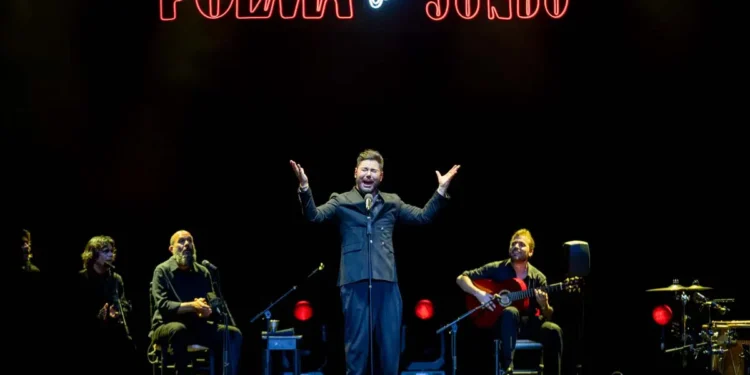
Next came the most exotic, risky and controversial ingredient of the program. Just two years ago, at this very festival, Miguel Poveda was seated in the front row as spectator, and on commenting upon his presence with friends, I discovered that the singer from Badalona was unknown in these parts. Tonight he had come with the airs of a star, and clearly had decided to triumph on his own terms. Take careful note of where we are: La Puebla de Cazalla’s cante festival, created by José Menese and Francisco Moreno Galván, champions of a nearly obsessive crusade to promote the most classic and traditional sort of cante, while rejecting the so-called “cante bonito” that had been so well-marketed by Niño de Marchena and followers, and which had dominated for decades. For this reason it was not only poor judgment, but baffling, that Poveda had decided to open with a long milonga, that saccharine-sweet form that typifies the “cante bonito” sound. The cool country air of the Andalusian countryside filled with the delicate arabesques of “Rosa Cautiva” by León, Quiroga and Quintera, popularized by Juan Valderrama, and we were transported to the year nineteen-fifty. Even taking into account that Pepe Marchena continues to be revered in these small towns of Seville province – Carmona, Estepa, Morón, El Arahal, Pruna, Coronil, Marchena of course – it was an odd calling card which provoked a certain amount of embarrassment in a portion of the audience, although, the truth be told, a couple of elderly people cheered the Catalonian singer effusively.

“How about a little soleá and siguiriya!” shouted a voice, but Poveda opted for cantiñas, once again with a Marchena sound, something he frankly does well. Had it not been for the dynamic and very flamenco guitar-playing of Juan Gómez “Chicuelo”, it was just like riding in a time-machine. “What a pretty voice!” shouted an older lady in the back. Malagueña ending with rondeña, and in an attempt to appease the restless crowd, martinete and siguiriya, but it was slick and painless. His bulerías could have righted all wrongs – Poveda knows how to sing traditional cante without concessions. But he chose instead to serve up a ‘cuplé’ in minor key, passing off a perfectly polished and utterly insubstantial product that just didn’t stick to the ribs.

Suspended in a flamenco dialogue of compás...who could dare glance away for a second...

Pepe Torres

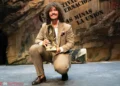
Next on the menu was dance, from the neighboring town of Morón de la Frontera. Pepe Torres, from the family of Diego del Gastor, a member of Son de la Frontera, came with his group displaying a fine, elegantly masculine line, with no need for long hair or extravagant costumes. Discreet echoes of the Farruco school, that never-ending source, credible, well-executed flashes and lots of compás, earning a standing ovation to end the first half.

Guitarist Antonio Soto opened the second part with a guitar solo and then suddenly the stage was flooded with the extravagant personality of the most authentic and experienced ‘festera’ of the current scene: María Teresa Sánchez Campos, “La Cañeta de Málaga”. She was all aflower in a bright red and white costume and flaming red hair, working the audience with all the expertise you’d expect from someone with over a half-century of performing experience. “I’m going to sing the tangos of my mother La Pirula”, but there was more Cañeta that Pirula, and it was all fresh, alive and very flamenco. A member of her group danced alegrías giving Cañeta a rest, and she came back strong for bulerías. She’d had enough of the mike and worked from the edge of the stage with frequent flashes of dance, art in every detail, and we were all suspended in the flamenco dialogue of compás with Soto’s prodigious thumb: who could dare glance away for a second.

The maestro didn’t sing – he held mass via the cantes that have marked his career

La Cañeta de Málaga

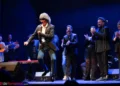
Few individuals could have filled the vacuum left by José Menese’s absence in La Puebla. The person who came to do it, pulled it off barely managing to sing. That gives you an idea of the dimension of Antonio Fernández Díaz “Fosforito” who is currently a candidate for the Llave de Oro del Cante, a seldom-awarded distinction reserved for true maestros. Rushing off from the Congreso de Guitarra in Córdoba to come to La Puebla at the mayor’s request, the maestro didn’t sing, he held mass via the cantes that have marked his career: soleá apolá, cantiñas, taranto and petenera. Nowadays few singers of a certain age can avoid a Fosforito sound precisely in those forms, because in the sixties and seventies, just as Antonio Mairena guided us through the labyrinth of soleá, siguiriya and tonás, this man was the ultimate source for nearly everything else. With his knowledge, his table for knocking out the compás, his unfailing dignity, a sense of humor and an overwhelming need to convey his cante, he won over an audience that wasn’t really his. The vocal chords no longer respond, but those of us who remember the singer’s glorious heyday when he was king of the festivals were able to fill in the notes he was unable to reproduce. The audience’s respect and affection hung heavy in the air, and the last taranto verse provoked tears throughout the audience: “I can’t go on, my strength is flagging, not even this taranto, can I finish, and it makes me want to cry”. He ended with bulerías, and the compás was all he needed to recall a classic repertoire that continues to play in the collective consciousness of all flamenco-lovers with a voice that is young and strong.


El maestro Fosforito with Antonio Soto


Pepa Montes

The festival could, and should have ended then and there, but there was still more dance, with Pepa Montes, and the guitar of her husband Ricardo Miño. They appeared with a discreet group for a performance that added little to the festival. On this night of good intentions and occasionally disappointing results, Montes had the most flimsy pretext with a dance that was not classic, but merely old-fashioned and passé, based on a hackneyed tablao-style routine with lots of footwork. Her veteran singer Paco Taranto seemed bored with his own singing, and the most attractive element was the red velvet dress the dancer wore.

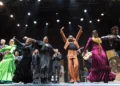
In La Puebla de Cazalla there’s always a fiesta finale. Carrión sang, Miño danced and each artist did a small bit except Clavel who finally wrapped up the festival with tonás, single-handedly, at 5 A.M.


Text & photos: Estela Zatania

More information:

XXXV Reunión de Cante Jondo - 2003

XXXVI Reunión de Cante Jondo - 2004

Interview with José Menese

Zaguan - Miguel Poveda

Diego Clavel
'Por los rincones de Huelva'

Fosforito


Store in Madrid - Contact - Advertising - Subscribe
deflamenco en tu email
pago seguro. Tienda on-line flamenco
© 2003 Tintes Flamencos S. L. Todos los derechos reservados - CIF - B83546655.
Included in the Official Registry of mail-order businesses (NEVA) 2003/0337/13/28/4/V
Design by Krama, Madrid