HOME - Deflamenco.com search
6th January 2009
Magazine Up-coming events Online shop Artist Places & People Courses
Updates News Interviews Show_reviews Cds_reviews Special_reports Articles Image_Galleries Videos


XLV Festival Internacional del Cante de las Minas

Mayte Martín y Belén Maya "Flamenco de Cámara"
Chano Lobato
Manuel Cuevas and group

Friday, August 5th, 2005. 10:45 pm. La Unión (Murcia)

All the information

Text & photos: Estela Zatania

La Union’s Festival Internacional del Cante de las Minas kicked off on Thursday the 4th with a keynote speech by Fernando Delgado, the performance of last year’s contest winners and the popular “velada trovera”. For those people not on top of Roman numerals beyond the “X”, “XVL” means this is the 45th edition of one of the most important yearly events in the world of flamenco.

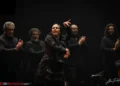
The first concert of the five scheduled began with a bang with Belén Maya and Mayte Martín. “Flamenco de Cámara” is the title of the work these two women put together a couple of years ago, taking it round the world with great success. The show is an reaffirmation of flamenco’s roots, and a statement about the need to express them through contemporary eyes that are not necessarily Andalusian since Mayte is from Catalonia in Northern Spain and Belén, aside from having been born in the United States, is the daugher of the great Granada dancer Mario Maya whose experimental nature contributed to the evolution and updating of traditional flamenco dance.

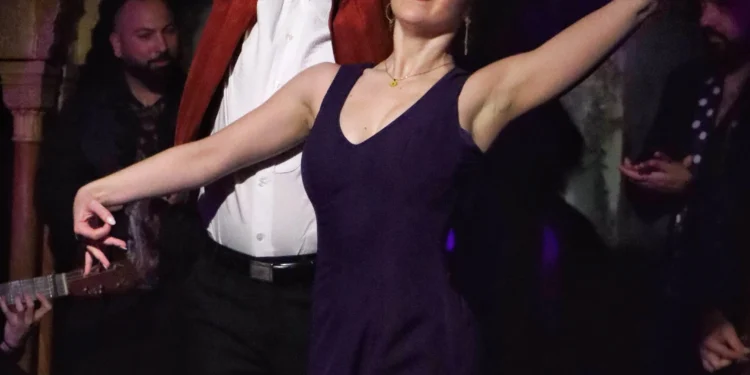
A discreet soleá opens the show – overall, “Flamenco de Cámara” is based on the rejection of flash, on technical perfection and absolute sincerity. Belén’s dance is sensual, cerebral, flirtateous at moments... Nearly always geometric – more than dance, Belén Maya sculpts, but the high relief is softened by ocasional moves which are surprisingly sweet and apparently ingenuous. Perhaps that’s the mark of great artists: the ability to manage opposing concepts in perfect equilibrium.

The mark of great artists is perhaps the ability to manage opposing concepts in perfect equilibrium.

The audience of La Unión is especially fond of sentimental cante, and the clean, flexible and perfectly tuned voice of Mayte Martín, as well the ease with which she delivers the most complex vocal arabesques, is the lady’s permanent key to succes in these parts. She’s clever enough to offer cante solos that include a vidalita, an old-style guajira and a garrotín, a sort of “three aces” of so-called “cante bonito”, and few people nowadays do it better.

Belén revives the dance of tientos that has fallen by the wayside in recent decades. Here she shows off her command of the ‘bata de cola’ and ends with tangos where the Granada influence is unmistakable.

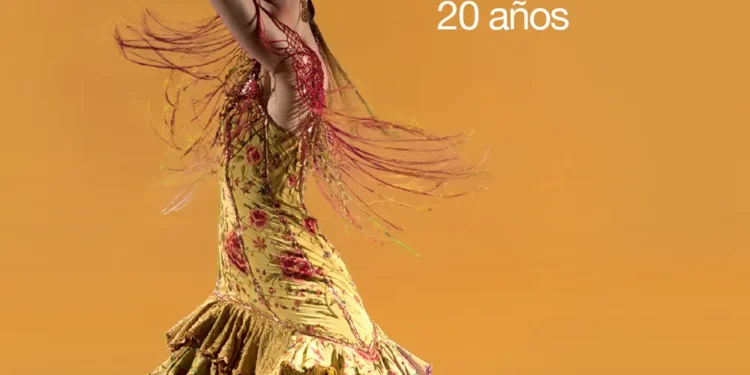
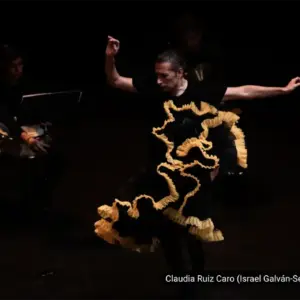
A guitar solo by José Luis Montón gives way to Belén’s alegrías which incorporates the violin of Olvido Lanza. The orange-yellow dress worn by the dancer is a brilliant touch that complements the refreshing perspective of a dance that goes down like lemon ices on the beach in Cádiz in mid-August...in flamenco, as in all things, well-defined flavors are a delight. The dancer recalls dance postures of earlier times giving them credibility with her impeccable good taste and a wall-to-wall smile that says she loves what she does. Mayte Martín treats us to a string of oldies but goodies from the Cádiz repertoire, ending with the traditional verse “Dios mío quién fuera blanco, aunque fuera catalán” [“Oh how I wish I were white, even if I were Catalonian!”]...god bless Mayte’s sense of humor.

A violin solo feels like a time-filler...it’s unfair to make artists competent in their respective fields present their work at innappropriate moments...and the show ends with taranto and rondeña finale. “Flamenco de Cámara” is a little flamenco jewel, perhaps a bit overworked after so many performances, but based on sure and admirable elements.

Chano always manages to get us all, young and old, Spanish and foreign, eating right out of his hand

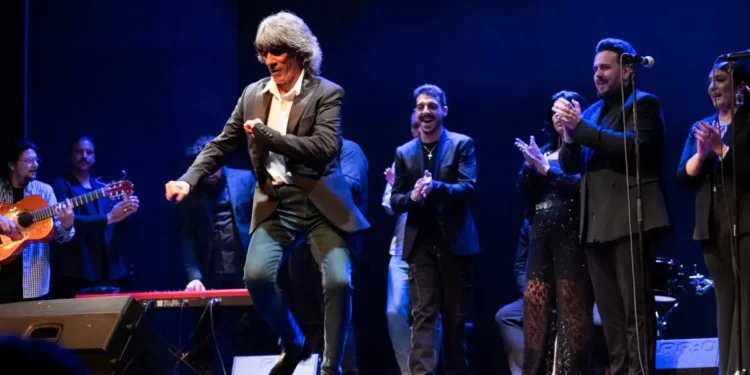
Viva Chano! What an artist, how elegantly he carries the years and how we enjoy every little thing he does. It’s impossible to write a serious critique of the maestro from Cádiz. In fact it’s quite a job to say anything at all about him not already known by flamenco-lovers everywhere: that the essence of Cádiz has been distilled and inhabits the person of Juan Ramírez Sarabia “Chano Lobato”. His appearance on stage triggers a warm ovation, and those who applaud out of pity – the man is pushing eighty and has a fragile appearance – are in for a surprise, because Chano always manages to get us all, young and old, Spanish and foreign, eating right out of his hand. There are other voices for the “basic” cantes...Chano’s is the one that most handily delivers alegrías, cantiñas, tanguillos, bulerías and other Cádiz delights. The nearly inaudible speaking voice sounds as if issuing from a flamenco Pavarotti with the first sung line, and the frail form which moves with difficulty, somehow takes on life and dances with energy and gusto. Flamenco is a powerful rejuvenating force and Chano Lobato is the best living example.

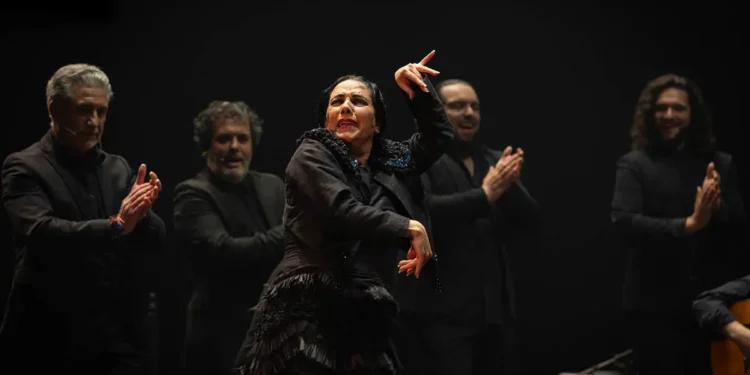
He apologizes to the local audience before singing “the cantes of this area, but to bulería rhythm, nice and slow, because singing Levante cante is very hard”. Tangos accompanied by Paco Cortés in E position, “a tidbit of soleá”, cantiñas that include classic alegrías, romeras and the Mirris cante preceded by the anecdote of how Ignacio Espeleta invented the famous “tiri ti tran” to disguise the fact that he was unable to remember his words: “some invention, the guy was drunk as a lord!” Cartagenera leads, as promised, into bulerías and a rumba finale – when Chano Lobato steps away from the mike to sing unamplified, you can hear a pin drop – with the most delightfully mischievous dance ever seen, and we’re all thinking the same thing: “that’s how I want to be when I’m his age”. One curtain call...and another and another... If the singer went a little over the top in recent years, that’s all now forgotten because the man has no time for superficiality and even the most festive cantes have all the substance of the best siguiriya interpretation another singer might offer.

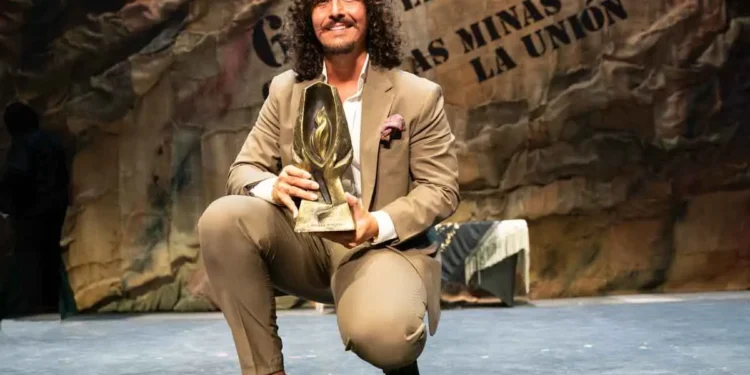
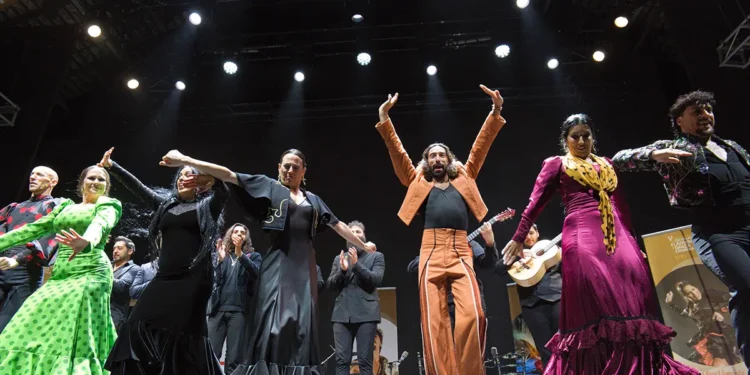
When the little hand on the big clock is coming up on 2, an intermission is announced before the second half and it’s like at Christmas dinner when you’re ready for a nap but they bring in the second turkey. It was a mistake to schedule such a long program and most of the audience fails to return for Manuel Cuevas and his group. The singer from Osuna who two years ago carried off the festival’s coveted Lámpara Minera has put together a show that sins in its blatant yearning to bring the house down, with a gorgeous dancer as green as spring wheat, with the imitation of formulas employed by others – pretty young girls singing chorus, instrumentation, percussion – and vocal pyrotechnics that pulled the wool over no eye left in the nearly empty theater. It is with deep regret we report that this man’s hard work and sacrifice is for naught...not even Caracol’s “Niña de Fuego” could save the show and we continue to savor the excellent taste left by the first half.


Ricardo Miño & Gualberto
'Contrastes'

Chano Lobato: el duende, la gracia y los dones -

Mayte Martin
Querencia

Mayte Martin
Freeboleros

Pack 5 CD
Festival Internacional Cante de las Minas

More information:

 
Store in Madrid - Contact - Advertising - Subscribe
deflamenco en tu email
pago seguro. Tienda on-line flamenco
© 2003 Tintes Flamencos S. L. Todos los derechos reservados - CIF - B83546655.
Included in the Official Registry of mail-order businesses (NEVA) 2003/0337/13/28/4/V
Design by Krama, Madrid