








HOME - Deflamenco.com search
9th February 2010
map shopping cart help


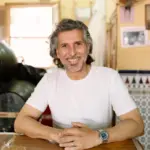
Interview with

Emilio Maya


In Granada’s flamenco history the surname Maya shines brightly in the person of Juan Maya “Marote”, the guitarist who transformed the panorama of flamenco guitar in the nineteen-sixties with his extraordinarily flamenco and personal style. In an interview with Marote shortly before his death I asked him about currently noteworthy Granada guitarists. He named but one, Emilio Maya, with whom he shares no family ties despite the name.

Emlio Maya was born in the coastal town of Molvízar in Granada province near Motril and Almuñécar into a gypsy family of itinerant merchants. At the age of 8 he began to play guitar and at 12 won his first contest in Lanjarón where he was the youngest contestant. In his lengthy career, in addition to performing at Spain’s most noteworthy tablaos and flamenco clubs, he has accompanied Enrique Morente, Marina Heredia and Estrella Morente as well as the dancing of Antonio Canales, Carmen Ledesma, Juan Andrés Maya, Juan de Juan and Carmen Montoya among many others.

There have also been collaborations with musicians from other fields such as Jorge Pardo, Rubém Dantas, Frank Holder and the Orquesta Andalusí from Tangiers, important influences that have enriched the musician without altering the innate flamenco quality of his artistic personality.

Following the release of his first recording “Temple”, the Deflamenco team went to Granada to interview Emilio Maya in the Andalamúsica recording studios located in the Albayzín where the work was recorded.


See CD

Emilio, what was your childhood like and how did you learn flamenco?
I learned from my cousins, the family, all my sisters sing, and really well, very flamenco, songs from Marelu, Amina, material you don’t hear any more…I learned by accompanying them. There are a lot of flamenco artists in Motril, wherever you find gypsies, we’re doing flamenco [he laughs], because it’s how we express ourselves, it’s how we communicate with the world. When I was a child we went through a lot because I had twelve brothers and sisters…I made some money selling cologne by the liquid measure and little bars of soap, door to door. For me the thought of having a banana was like a dream come true. My mother always reminds me of this anecdote from when I was small…my father had gotten drunk one time and he fell sound asleep on the couch, you know how you sleep like that, really passed out, and I whispered to my mother “Mom, mom! Now that Daddy’s dead, why don’t you take some money for bananas?!” My mother won’t let me forget that! So when you say how I started playing guitar…I played because I had no choice if I wanted to get by. Now my family’s doing very well…I’m the worst of the lot! [laughter]

“A lot of people are coming on strong from Granada”

Have you been living a long time in Granada?
Eight years I’ve been living here in the capital, I’m from the coast of the province, the tropics [he laughs]. I came here because my girlfriend, the dancer Ana Calí, was studying law here…she’s on the record by the way, dancing the zapateado, really nice, I had this idea I wanted to revive the old custom of those records with dance made by Carmen Amaya and Antonio Gades, they don’t do that any more you know, we have to bring back the old things or else they’ll be lost forever. Then I had a friend, Juan Santos, who had opened Eshavira [a hangout for Granada’s flamenco artists], I saw the scene there was and liked it. I lived in Seville for seven years, the guitarist Quique Paredes got me in the tablao El Arenal. He’d seen me playing in Nerja and said “hey, what are you doing here boy?…come to Seville with me”. That was in 1984 when Carmen Montoya, Lalo Tejada, Carmen Ledesma, the whole Fernández family, Ana María Bueno, all important artists were working there. Later on I went to London for three years to see what I could learn about music. I returned to Granada in 1993 and the maestro Enrique Morente was the first one to call. I recorded with his daughter Estrella on her second record, and also worked with a lot of other people, Marina Heredia, Chonchi Heredia, Canales…

What do you think about the place Granada occupies in the current flamenco scene?
It didn’t used to be very good, but now there are a lot of people all coming on strong, just like in Sevile or Cádiz or anywhere else…before, it was just the maestro Enrique and the maestro Habichuela… Marote was in Madrid for many years and I was always dying to spend time with him… In his later years, thank God, I got to know him personally. In any case, nowadays people are beginning to realize that here in Granada there’s quality flamenco. Nevertheless, mostly outside artists work here, and that’s very stimulating as well…we give them their place and know how to value them, and they also learn from us.

How would you evaluate the overall state of flamenco?
I think it’s very good, it’s always a good time for flamenco because the music is constantly becoming enriched…we can’t be listening to the same thing all the time, I mean, the history of flamenco is there for everyone to listen to and learn from, day after day, but we can’t lock ourselves up in that. I’m 42 years old and I like modern flamenco, but I respect what went before, and I also know what today’s flamenco is about, the paths it’s taking, and they’re good because a great deal of culture is coming into flamenco from some very good music which is enriching it. You have to consider the entire product that’s come out, both good and bad, it’s all been responsible for opening flamenco up to the world, the people who went before weren’t able to accomplish that, it’s something the present generation has done. The old maestros are there in the recordings and we’ve learned from them.

Do you rehearse many hours?
As much as I can, some days more, some less…


“A great deal of culture is coming into flamenco from some very good music which is enriching it”

What guitarists have inspired you?
I’ve always admired Paco de Lucía very much…I take from anything, Cádiz, Jerez, Sevilla, that’s how I am, and I adapt it to my own personality. I like Tomate, Sanlúcar, Vicente Amigo, Gerardo…and of the old guitarists, Ricardo, Sabicas, you have to look to the past. But Paco is the reason I play guitar today…when I was a little boy and his record Entre dos Aguas came out, I bought it three times because the grooves got worn out from playing it, and I drove my mother crazy, “that kid! always with the same guitar record!”…and I just kept playing it and playing… Paco has always been the mirror I look into to find myself. I also remember when I was six or seven, every day at one o’clock, when my mother was making lunch, I knew there was flamenco on the radio with the big knobs…you didn’t hear Camarón yet, so I listened to all the old singers, and to Ricardo and Melchor… But I never paid as much attention as when Paco came along, that completely changed my musical sense. And now they’ve given him that prize, they should have given it to Camarón too, poor guy, because those two are the ones who are responsible for putting flamenco where it is today. Camarón had this thing, that he combined the old and the new, and for today’s youth he’s the old master.

Being from Granada, do you feel more at ease with tangos and rumbas?
I feel good with anything that’s good…well, rumba, that’s something else. I like taranto, soleá, siguiriya…those are things that make you hurt, that’s where I have to find myself and bring out the good stuff, a weighty strum applied at the right moment… On the record there’s minera, rondeña, alegrías, tangos, rumba, bulerías and zapateado. I don’t do pop or anything wierd, I do flamenco. When something doesn’t feel right, or if I feel uncomfortable with it, I distance myself from it…I just want my guitar and to do what I know how to do, which is play it.

How long have you been preparing the pieces on this record?
Years. There are some things there I’ve been working for eight or nine years, material I’ve been playing live in performance, and now I’ve updated it…but it’s all mine, and many years it’s taken to see that each composition has its own identity and history, you can’t do that in one day.

The zapateado is unusual...
Yes, in zapateado you’ve always got two rhythms going, three fourths and four fourths, so there are moments when it sounds like tangos, and others when it sounds like bulerías, and it’s in the flamenco cadence of E-F…only at the very end I go into the more common tones for zapateado. Me and Ana are going to do this zapateado in London next month at the Festival de la Guitarra, we’re going to break it in live…then on to Melilla, La Unión…

Is there any story behind the piece you call “Eshavira”?
We incorporated a cello, this Basque woman who lives here in Granada, Arantxa Hernáiz. The composition is a rondeña I’ve worked a great deal, never forgetting the maestro Montoya. I tried to evoke everything I’ve experienced here Granada, I often went to the monastery, that inspires me to create. I think the end result shows all the tender loving care that went into that piece.

Then there’s the alegrías... Since I’m from the coast, once in a while that smell of salt spray would reach us and that’s a powerful childhood memory, of the boats, that smell stuck with me and that’s why the piece is called “Salitre”. The record contains many different influences, the wind from the Levante is there too…

The bulerías is 100% pure Jerez...
Yes, the singers helped a lot, there’s one who sounds like Borrico, another like Zambo…that was my idea, to put together a fiesta as if we were in Jerez, but with a Granada feel. There are sounds of Lebrija, Morón, Jerez, Granada, whatever you want to find is there. We put the whole thing together in one night, lots of art…the bottle of whiskey, the olives and jam on the table, we were all feeling right at home and the recording speaks for itself…it’s the only piece on the record that wasn’t prepared ahead of time, we just went and did it.

You don’t sing there, do you?
[He laughs] No…there are a few takes where I’m singing, but I didn’t like it at all…I had thought of sticking on a short bit, maybe next time.

Are you a cante fan?
All my life. I like singing more than playing guitar…like all flamenco guitarists, I’m a frustrated singer [laughter]. But yes, I’m crazy about cante.

Is there such a thing as Granada-style bulerías?
Well, we’ve got this thing we call “bulería corría” which is very fast bulerías with lots of ‘jaleo’, for dancing, like they do in the caves here.

“Nowadays there’s lots of technique, they devour the guitar, but there’s no depth, no definition”

What does the immediate future hold for you?
What I’d love to do would be to work with my group from the recording, as a soloist, but the market is very tough, and since I also accompany cante and baile, I’m always involved in things, a good guitarist has to know how to play everything in flamenco. That’s what’s lacking in today’s young guitarists…they’ve got lots of technique, they devour the guitar, but there’s no depth, no definition. When a guitarist connects with his guitar, he’s looking for himself, and finally you say ‘now he and the instrument are one’. Sometimes the guitar gets the better of you, your picado doesn’t come out, one thing or another doesn’t sound right…the good thing when you’re playing is to be on top of everything, the sound comes and you enjoy yourself. I’ve reached that point and I’m delighted to have achieved this. The years put everything in order, it’s about maturing, like the best serrano hams, you smell them and “mmmm, fantastic aroma!” [laughter].

Do you enjoy accompanying or do you prefer playing solo?
I love accompanying when it’s someone I feel comfortable with, but not if I have to suffer, and I have just as much fun playing solo as accompanying. In order to be a good flamenco soloist you have to have played for 30,000 singers. Now I’m going to start playing for Rafael de Utrera, a tour of the U.S. starting Septemer 6th, with dancer Rafael del Carmen as well. In November I’m going to Japan, then Belgium… I’ve been playing since the age of eight, and now finally things are coming together on a more decent level…you have to sow in order to reap.


Text & photos: Estela Zatania


Store in Madrid - Contact - Advertising - Subscribe
deflamenco en tu email
pago seguro. Tienda on-line flamenco
© 2003 Tintes Flamencos S. L. Todos los derechos reservados - CIF - B83546655.
Included in the Official Registry of mail-order businesses (NEVA) 2003/0337/13/28/4/V
Design by Krama, Madrid