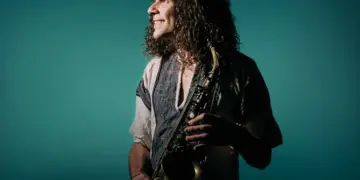
PACO
DEL POZO
«It's thanks to Camarón I'm into this»
He's 28 years old and has been singing for 20. In
1997 after four tries he finally won the Lámpara
Minera at La Unión. He feels a strong attachment
to classic flamenco, but his generation has also influenced
him. Here he presents his new «half-and-half»
record – six classic cantes, and another six not so
classic. «Vestido de luces» with a bullfight
motif includes twelve songs in honor of the Ordóñez
bullfighting dynasty with texts by contemporary poets
such as Gerardo Diego, Antonio Murciano and Ángel
Peralta.
Paco, in your biography it
says you won the prize for best new flamenco singer
in Madrid in 1986, but how old are you?
Well, I'm 28, that was when I was eleven, and I've been
singing as far back as I can remember, I learned to
sing before learning to walk. From the age of three
I sang, imitated everyone, not flamenco of course, but
anything and everything.
But
there aren't any flamenco artists in your family, and
not that much flamenco in Madrid. How did you develop
the interest?
And even less flamenco where I live, in San Sebastián
de los Reyes, not exactly a flamenco neighborhood. When
I was little I used to go with my father when he got
together with his friends and they would sing Los Chichos,
Los Chunguitos…I learned those songs and little by
little I got into flamenco. Later on it was Lole and
Manuel and finally Camarón, when I was 8 or 9.
It's thanks to Camarón I'm into this.
You say Camarón inspired
you, which era of Camarón?
Everything, I latched onto him during the era of 'Como
el Agua', but I got hooked on his voice and his way
of singing and I bought everything, the earlier stuff
and the new material too. I sang everything of Camarón's
and knew everything.
By the time I was 13 or 14 I went to learn from a maestro,
Pepe Pucherot, with the late Paco de Antequera, the
only important guitarist around Alcobendas. He was the
one who started giving me records to listen to, and
all sorts of cante, I only knew Camarón and thanks
to the records I began learning other cantes.
Then I came to Madrid, to the flamenco circuit, I was
singing in Corral de la Morería for dancing,
and little by little I worked my way into flamenco circles,
but it's hard to get in.
You also signed up for a
series of contests as a way of getting known…
For someone like me it's one of the few ways there are,
when you don't have the family background and weren't
born in a flamenco neighborhood, you have no choice
but to enter contests, in my town and outside…then
they told me about La Unión, and I went four
years in a row. The first year they gave me the prize
for best new singer, then, for the best levantica. The
third year I was finalist and finally the fourth year,
Lámpara Minera.
Winning the Lámpara
Minera doesn't necessarily guarantee success…
Certainly not, but it served the purpose, at least for
me, it was the definitive push forward to make the move
and go professional.
In flamenco, how long are
you considered young? It's been a long time since 1986,
What does it take, 3 or 4 records?
If I knew what it took…I've been singing since the
age of 8 and now I'm 28, that's 20 years singing, but
in my opinion a singer, because of maturity, the passage
of time, voice, personal maturity, I think that 40 is
maybe the optimum age, until that time you could say
someone's a young singer.
To get into important festivals
and the professional circuit, is it absolutely necessary
to have recorded?
That might be so, but I wasn't offered any recording
contract after winning the Lámpara Minera as
happened with Miguel Poveda for example. But if you
want to know what I think, in Barcelona they take much
better care of their artists, they defend and support
them no matter what, which I think is amazing, but here
in Madrid, despite there being good raw material, they
seem to be more interested in the singers from down
south and they've rather forgotten about us.
You're
very much admired by purists. What school are you from,
if that even applies?
I've always sung classic cante, if you want to call
it that, I've sung the way I've seen fit, starting with
Camarón, but I've listened to Juan Talega, Terremoto,
Chocolate, Niña de los Peines and I've also been
into the «new tendencies», I was working many
years with a jazz group «Jazz Hondo», and
with José María Gallardo, a classical
guitarist. I've always liked music although I identify
more with traditional cante. I like orthodox cante,
then I put my own personality into each cante, keeping
the roots intact but doing it my way.
Have you found your path
then, or are you still looking?
I think so, it's hard to find, every so often you change
things, but without a doubt your cante matures. Generally
speaking I don't think I sound like anyone else, I sing
the way I feel, without trying to imitate anyone.
Do you consider your record
to be traditional flamenco?
I consider it traditional because it's traditional.
The record was produced by Jorge Pardo and Jerónimo
Maya, Carles Benavent is on it, there are choruses,
percussion, piano, a cello… there are 12 cantes and
a little of everything, it all balances out.
What's on the record, what
are the most commercial numbers?
It starts out with tangos by Jorge Pardo with bass and
guitar…perhaps the rumba is the most commercial number,
'Vestido de Luces', with a good chorus, very pretty
and flamenco, that's how I sing it. Then you have a
malagueña with a rondeña, some alegrías
of my own, a seguiriya of Jerónimo Maya, more
traditional you can't get. Out of twelve cantes, six
are basic forms and the other six have more ingredients.
Do you think your purist
fans will be disappointed?
I hope not, I think you can tell the record is sung
pure and with feeling in addition to being well-done,
I think. Like I said, there's the seguiriya, toná,
soleá, fandangos, I think there's something for
everyone, I tried to cater to all tastes and please
myself as well, to identify with the record.
What's your relationship
with bullfighting?
Right now, a very close one, because of the record,
but when they proposed it to me, it wasn't like that,
I'm not a connoisseur but I've liked it ever since I
was small.
Who proposed the idea to
you?
The Aula de Cultura of the Universidad Menéndez
y Pelayo called Venencia, who collaborated on the record,
they offered me this project based on a book about bullfighting
that's a tribute to the Ordóñez family,
Niño de Palma, Antonio Ordóñez,
Rivera Ordóñez, Paquirri, la Maestranza…
Their proposed the recording, I liked the idea and I
had trustworthy people to back me up.
Where did you get the verses?
They're from Andalusian poets, but we tried to choose
contemporary poets, mostly living ones, except for Gerardo
Diego, a poet from Santander who wrote about bulls,
but not exclusively. There's also Ángel Peralta
from Málaga – a mounted bullfighter – and Antonio
Murciano who wrote a great deal for flamenco, for Fosforito,
Menese…but above all we wanted it to be a fresh sound
with up-to-date poetry related to the world of bullfighting,
particularly about the Ordóñez dynasty.
In a certain way it opens
up another audience, the bullfight fans…
Yes, that's right, next month we're going to Santarem,
to perform at the world bullfighting congress. Flamenco
and bullfighting have always been bedfellows.
For live performance, how's
the group set up?
Up til now it's always been guitar and voice, nearly
always with Jerónimo, but we need more people,
it depends, there are six or seven cantes on the record
that only need a guitar, but others use percussion,
electric bass, they can sound better but it's not necessary.
We're going to do a presentation of the record at the
Fnac in Madrid, and try to go to Ronda (Málaga)
to the bull-ring and also here at Las Ventas, I'll be
at the Festival de Solidarios in Santarem….and what
comes up along the way…
There's a flamenco club with
your name, isn't there?
Yes, it's a group of flamenco fans from San Sebastián
de los Reyes and they wanted to make a peña,
they knew I lived there, that I'd won the Lámpara
Minera, so they came and talked about it and naturally
I'm delighted.
PACO
DEL POZO
«It's thanks to Camarón I'm into this»
He's 28 years old and has been singing for 20. In
1997 after four tries he finally won the Lámpara
Minera at La Unión. He feels a strong attachment
to classic flamenco, but his generation has also influenced
him. Here he presents his new «half-and-half»
record – six classic cantes, and another six not so
classic. «Vestido de luces» with a bullfight
motif includes twelve songs in honor of the Ordóñez
bullfighting dynasty with texts by contemporary poets
such as Gerardo Diego, Antonio Murciano and Ángel
Peralta.
Paco, in your biography it
says you won the prize for best new flamenco singer
in Madrid in 1986, but how old are you?
Well, I'm 28, that was when I was eleven, and I've been
singing as far back as I can remember, I learned to
sing before learning to walk. From the age of three
I sang, imitated everyone, not flamenco of course, but
anything and everything.
But
there aren't any flamenco artists in your family, and
not that much flamenco in Madrid. How did you develop
the interest?
And even less flamenco where I live, in San Sebastián
de los Reyes, not exactly a flamenco neighborhood. When
I was little I used to go with my father when he got
together with his friends and they would sing Los Chichos,
Los Chunguitos…I learned those songs and little by
little I got into flamenco. Later on it was Lole and
Manuel and finally Camarón, when I was 8 or 9.
It's thanks to Camarón I'm into this.
You say Camarón inspired
you, which era of Camarón?
Everything, I latched onto him during the era of 'Como
el Agua', but I got hooked on his voice and his way
of singing and I bought everything, the earlier stuff
and the new material too. I sang everything of Camarón's
and knew everything.
By the time I was 13 or 14 I went to learn from a maestro,
Pepe Pucherot, with the late Paco de Antequera, the
only important guitarist around Alcobendas. He was the
one who started giving me records to listen to, and
all sorts of cante, I only knew Camarón and thanks
to the records I began learning other cantes.
Then I came to Madrid, to the flamenco circuit, I was
singing in Corral de la Morería for dancing,
and little by little I worked my way into flamenco circles,
but it's hard to get in.
You also signed up for a
series of contests as a way of getting known…
For someone like me it's one of the few ways there are,
when you don't have the family background and weren't
born in a flamenco neighborhood, you have no choice
but to enter contests, in my town and outside…then
they told me about La Unión, and I went four
years in a row. The first year they gave me the prize
for best new singer, then, for the best levantica. The
third year I was finalist and finally the fourth year,
Lámpara Minera.
Winning the Lámpara
Minera doesn't necessarily guarantee success…
Certainly not, but it served the purpose, at least for
me, it was the definitive push forward to make the move
and go professional.
In flamenco, how long are
you considered young? It's been a long time since 1986,
What does it take, 3 or 4 records?
If I knew what it took…I've been singing since the
age of 8 and now I'm 28, that's 20 years singing, but
in my opinion a singer, because of maturity, the passage
of time, voice, personal maturity, I think that 40 is
maybe the optimum age, until that time you could say
someone's a young singer.
To get into important festivals
and the professional circuit, is it absolutely necessary
to have recorded?
That might be so, but I wasn't offered any recording
contract after winning the Lámpara Minera as
happened with Miguel Poveda for example. But if you
want to know what I think, in Barcelona they take much
better care of their artists, they defend and support
them no matter what, which I think is amazing, but here
in Madrid, despite there being good raw material, they
seem to be more interested in the singers from down
south and they've rather forgotten about us.
You're
very much admired by purists. What school are you from,
if that even applies?
I've always sung classic cante, if you want to call
it that, I've sung the way I've seen fit, starting with
Camarón, but I've listened to Juan Talega, Terremoto,
Chocolate, Niña de los Peines and I've also been
into the «new tendencies», I was working many
years with a jazz group «Jazz Hondo», and
with José María Gallardo, a classical
guitarist. I've always liked music although I identify
more with traditional cante. I like orthodox cante,
then I put my own personality into each cante, keeping
the roots intact but doing it my way.
Have you found your path
then, or are you still looking?
I think so, it's hard to find, every so often you change
things, but without a doubt your cante matures. Generally
speaking I don't think I sound like anyone else, I sing
the way I feel, without trying to imitate anyone.
Do you consider your record
to be traditional flamenco?
I consider it traditional because it's traditional.
The record was produced by Jorge Pardo and Jerónimo
Maya, Carles Benavent is on it, there are choruses,
percussion, piano, a cello… there are 12 cantes and
a little of everything, it all balances out.
What's on the record, what
are the most commercial numbers?
It starts out with tangos by Jorge Pardo with bass and
guitar…perhaps the rumba is the most commercial number,
'Vestido de Luces', with a good chorus, very pretty
and flamenco, that's how I sing it. Then you have a
malagueña with a rondeña, some alegrías
of my own, a seguiriya of Jerónimo Maya, more
traditional you can't get. Out of twelve cantes, six
are basic forms and the other six have more ingredients.
Do you think your purist
fans will be disappointed?
I hope not, I think you can tell the record is sung
pure and with feeling in addition to being well-done,
I think. Like I said, there's the seguiriya, toná,
soleá, fandangos, I think there's something for
everyone, I tried to cater to all tastes and please
myself as well, to identify with the record.
What's your relationship
with bullfighting?
Right now, a very close one, because of the record,
but when they proposed it to me, it wasn't like that,
I'm not a connoisseur but I've liked it ever since I
was small.
Who proposed the idea to
you?
The Aula de Cultura of the Universidad Menéndez
y Pelayo called Venencia, who collaborated on the record,
they offered me this project based on a book about bullfighting
that's a tribute to the Ordóñez family,
Niño de Palma, Antonio Ordóñez,
Rivera Ordóñez, Paquirri, la Maestranza…
Their proposed the recording, I liked the idea and I
had trustworthy people to back me up.
Where did you get the verses?
They're from Andalusian poets, but we tried to choose
contemporary poets, mostly living ones, except for Gerardo
Diego, a poet from Santander who wrote about bulls,
but not exclusively. There's also Ángel Peralta
from Málaga – a mounted bullfighter – and Antonio
Murciano who wrote a great deal for flamenco, for Fosforito,
Menese…but above all we wanted it to be a fresh sound
with up-to-date poetry related to the world of bullfighting,
particularly about the Ordóñez dynasty.
In a certain way it opens
up another audience, the bullfight fans…
Yes, that's right, next month we're going to Santarem,
to perform at the world bullfighting congress. Flamenco
and bullfighting have always been bedfellows.
For live performance, how's
the group set up?
Up til now it's always been guitar and voice, nearly
always with Jerónimo, but we need more people,
it depends, there are six or seven cantes on the record
that only need a guitar, but others use percussion,
electric bass, they can sound better but it's not necessary.
We're going to do a presentation of the record at the
Fnac in Madrid, and try to go to Ronda (Málaga)
to the bull-ring and also here at Las Ventas, I'll be
at the Festival de Solidarios in Santarem….and what
comes up along the way…
There's a flamenco club with
your name, isn't there?
Yes, it's a group of flamenco fans from San Sebastián
de los Reyes and they wanted to make a peña,
they knew I lived there, that I'd won the Lámpara
Minera, so they came and talked about it and naturally
I'm delighted.
Utilizamos cookies para asegurar que damos la mejor experiencia al usuario y obtener estadísticas en nuestro sitio web. Si continúa utilizando este sitio asumiremos que está de acuerdo. Más info:


 You're