Interview
with
JUAN CARLOS ROMERO «When you play
for singing you’re helping someone else communicate…but
when you play solo it’s your own communication
«
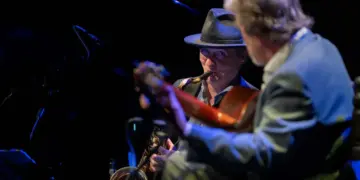
Juan Carlos Romero, flamenco guitarist
from Huelva. He began to play guitar with his father and his
first teacher Miguel de Tomate at the age of 8, and later
on, with Manolo Sanlúcar. As an adolescent he was accompanying
major stars of dance and cante when he played for Matilde
Coral’s dance classes and he has developed a parallel
career in composing original music for dance and for cante
records as well as two recordings of his own including “Azulejo”.
He has now just released his new work “Romero”
with important guest artists such as Estrella Morente, Eva
Yerbabuena and of course, Arcángel, the singer he’s
accompanied since the very beginning.
Is there much tradition of flamenco
guitar in Huelva?
Not much, but there have been a couple of important names,
one is Manolo de Huelva, and another, Niño Miguel,
the former with a very long professional history, and the
latter, very short because he stopped playing very young.
Manolo de Huelva needs no presentation, he was an excellent
guitarist. Niño Miguel might require some background
information for younger flamenco fans since he isn’t
really well-known and he was one of the best guitarists I
ever heard and someone I greatly admire.
Is Niño Miguel a role model
for you?
Yes, he was for a very long time…I learned to play guitar
with his father, and the son used to come to my house, I was
8 when I met Niño Miguel.
Like so many guitarists, your interest
in the guitar began with your father…
Yes, my father played guitar and got me started, then we went
to Miguel el Tomate from Almería, Niño Miguel’s
father and Tomatito’s grandfather. That’s how
I came in contact with Miguel, not as a teacher, because that
was his father, but as a model to look up to. And of course
Paco de Lucía is a reference for any guitarist.
You began accompanying at a very
early age. Did you start working as soon as you learned accompaniment?
Who have you worked with?
I started out in Matilde Coral’s dance school, that’s
where I met Chano Lobato, Boquerón, Romerito, a series
singers who sang for dance, and I began to play for them.
A lot of singers used to show up, amateurs, people from flamenco
clubs, contest winners…I did a lot of cante accompaniment.
Since you were just a kid they
used you to accompany…
Obviously, and I was delighted, I really learned a lot, playing
for cante is a profession, I learned to accompany flamenco
singing and to understand it, and this is important in order
to play the guitar.
Then you met Manolo Sanlúcar.
He was also someone you looked up to.
I met him at a course he was giving in Jerez, that’s
where I met him personally and afterwards he called me to
play with him. I spent 5 or 6 years playing in his group,
learning to give form to the different styles more than actual
technique. Manolo is probably one of the best teachers a guitarist
could possibly have.
Where do you feel the most comfortable,
accompanying, playing solo or composing?
I’m comfortable with all three, but right now playing
solo is more important for me, when you play for singing you’re
helping someone else communicate, and I’m happy to do
that, but when you play solo it’s your own communication,
and logically I prefer that.
But in your case it isn’t
just accompaniment, you’ve also created music although
it’s been for accompanying.
When I compose for other people I’m helping them carry
on a conversation, but in those cases the singer is an intermediary
and it’s harder to compose and be true to oneself, because
what you have in your head is difficult to put in someone
else’s mouth, the subtleties, small details that slip
by…
With
someone like Arcángel, what’s the creative process
for making one of his records?
I spend time at home working up the basic themes, we decide
what traditional cantes are going to be on the record and
what are going to be new compositions, then I get working,
we get together and rehearse, try things out…
You’ve been with Arcángel
since the very beginning. What part have you played in his
career?
As it stands now, I composed nearly everything for his two
recordings.
Nowadays, the way things are,
guitarists and musicians in general have a hard time
You’ve been accompanying Miguel
Poveda in some concerts these days, and also Estrella Morente,
Arcángel…would you say you’re accompanying
the most promising young singers?
If anything’s been accomplished, I suppose it’s
that they identify with my style of accompaniment and way
of doing things, and of course I identify with them and we’ve
got a good rapport.
Tell us about your plans with Miguel
Poveda…isn’t there a record in the works?
We’ve got plans of making a record, and the concepts
are pretty well outlined…the next step is to look at
each composition, work it, focus the cantes…
But won’t you have to give
your own record a chance to sink in first?
That’s another thing, studio work really burns you out,
and preparing two recordings simultaneously…I need some
down time.
Solo guitar recordings are made
because a musician has to make his work known, but the commercial
angle is complicated…
Yes, especially the necessity I feel of getting my stuff out
there, that’s the whole purpose of it, even though I
know it’s very hard to sell, but there’s nothing
that can be done about that, you have to create and compose,
spew it out…nowadays, the way things are, guitarists
and musicians in general have a hard time.
“Azulejo” was your first
record…how many years ago was that?
Gee, at least six, you can hardly find it any more actually.
With a second recording you’re
looking for something more than just making your music known.
I want it to reach the greatest number of people possible,
I was looking for a specifica artistic concept and I think
I’ve come very close. For better or worse I think I’m
sincere when I compose. On this record I did exactly what
I wanted, there were not preconditions, no concessions were
made, which is why I think the result is very close to what
I wanted.
Is this a guitarist’s record?
I think it’s a record for music-lovers, and if they
have a background in flamenco they’ll appreciate it
even more, but if not, I think flamenco is a universal language
that any musician can understand.
The taranta “Río Tinto” is the only piece
that’s guitar alone…is that the most personal composition?
No, in that sense it’s hard for me to pick out one favorite
theme, I feel very good about the whole record, there are
personal references, emotions, memories, things that happen
to you over time and then you make music based on what you’ve
experienced, enjoyed, suffered…I try to make all that
into music. The taranta is a composition dedicated to Niño
Miguel and for me it’s very emotional, someone I’ve
always admired, as well as a friend. Also the fandangos “Campana
de Alosno”, which I dedicate to Paco Toronjo whom I
knew personally and have always admired. The whole record
is full of emotions.
On this record I did exactly what
I wanted, there were not preconditions, no concessions were
made
The opening number, alegrías,
“Tran Tran” where Arcángel sings…is
that the record’s letter of presentation?
Yes, in a certain sense is the letter of presentation, but
the order in which the pieces come is carefully considered
from a musician’s point of view in order to make the
listening flow, and that’s what we took into consideration.
You’ve got Estrella Morente
singing sevillanas and fandangos…how did you manage to get
her?
Like I mentioned earlier, we’ve got a good relationship,
with her father, her family and with Estrella herself…I
called her to say I had two numbers on the record that I thought
were perfect for her, and as always she was warm and anxious
to lend a hand, so she came to Seville and sang that increible
stuff.
Eva Yerbabuena also contributes
the sound of her feet for the farruca, doesn’t she…
When Eva was starting out as a dancer, she would come along
to guitar recitals and we were great friends, she and her
husband Paco Jarana…so I mentioned the idea to her and
she quickly said she’d do it.
This is a flamenco record, but you
also include other elements. How did you use those things,
like the oud, or gospel music?
If you notice, these things only come in the last pieces,
the rest is pretty much straight guitar and percussion, guitar
and palmas, voz, traditional flamenco elements – percussion
is now almost considered an element of flamenco, and for sevillanas
we thought of the oud, each sevillana is in a different tone
and for the transition from one tone to another, I wanted
an instrument that had nothing to do with strings, that was
ethnic, but closely linked to flamenco, and the Arabic oud
seemed the most appropriate. In the last sevillana there’s
no oud and the gospel voices come in, I think there’s
a close relationship between blacks and flamenco and this
becomes evident in the last piece. It was something I’d
had in mind for a long time because I saw that kinship between
the two cultures.
The rumba, which isn’t really flamenco but is close,
just like sevillanas, allowed me a certain artistic license,
I think in those forms you have a lot more leeway.
Everyone always talks about the
evolution of the guitar, how it was advanced by Serranito,
Sanlúcar and Paco de Lucía. Do you think Paco
de Lucía has been surpassed or is he still the most
important figure?
Without any doubt Paco continues to be the undisputed leader
of all the guitarists, but what is true is that nowadays we
have a broader vision, we not only look to other guitarists,
but other kinds of music, perhaps before everything was mostly
focused on Paco, and from a guitar point of view that continues
to be true, but my generation is exploring other kinds of
music, we know we need information, material to keep heading
down the path. He is a guiding-light for all lot us, the most
important guitarist in history, you can’t overlook someone
like Paco, it would be ridiculous.
What about the evolution of cante
which you’re also qualified to talk about?
It’s more difficult for cante to evolve than guitar
because of certain physical realities. In the human voice
there’s only one melodic line, but with guitar there
are six, there’s more to work with. Cante has very little
margin to advance, interesting things have been done, but
mostly regarding form.
So then does each singer have to
find his or her own identity?
It can be done, you can construct melodies in a different
way, the difference isn’t in what you sing or how you
sing it, but rather in the form, although we should really
get down to basics and try to construe the melody in other
ways.
Paco de Lucía is the most
important guitarist in history, you can’t overlook someone
like him, it would be ridiculous.
Then do you think a lot more can
be done?
Yes.
Is
guitar the most difficult way of finding your own identity?
Finding your identity is never easy. A person’s voice
is almost like their fingerprint, the singer has it from the
day he or she is born, but in music you have to look for it
and create it, and that’s perhaps a guitarist’s
greatest achievement, of course we talking about doing it
will a certain level of quality, being able to have a personality
is of utmost importance.
Is technique absolutely essential?
It depends on what you want to play, you have to have adequate
technique for what you’re doing, if you want to do a
‘picado’ run at 190 beats per minute, you better
know what you’re doing…technique is a tool at
the service of art, not an end in itself.
Did you participate in the Bienal?
No, I didn’t.
Did you attend any of the shows?
Yes, I saw Paco, Eva, Israel…
Anything else, or was that all you
liked?
No, I just saw those three.
What did you think of the Bienal
in general?
Those shows I saw were very good… I can’t speak about
the rest, but from what I heard it wasn’t very good,
but I can’t give an opinion based only on what I saw.
With a new record out in September,
shouldn’t you have been at the Bienal?
I submitted a proposal but the answer was I’d have to
do alternative venues, terraces, gardens and so forth…obviously
I wasn’t interested in this so I turned it down.
But you’ve been at other Bienals
since 1992, haven’t you?
Yes, yes, at the Lope de Vega…but what they offered was
that, alternative venues…
What about the presentation of your
record “Romero”?
We’re working on that, we want to do a presentation
in Madrid, but there’s no date yet, then Seville in
January, but I can’t tell you the place yet. Then we’ll
do another in Barcelona
And are you going to continue to
accompany cante?
Always, whenever I’m needed…with Carmen Linares,
Miguel…that will never stop…
Texto y fotos. Rafael Manjavacas Lara
CD related:
Juan
Carlos Romero
'Azulejo'
Juan Carlos Romero
'Romero'
Arcángel
'Arcángel'
Arcángel
'La calle perdía'
Interview
with
JUAN CARLOS ROMERO «When you play
for singing you’re helping someone else communicate…but
when you play solo it’s your own communication
«
Juan Carlos Romero, flamenco guitarist
from Huelva. He began to play guitar with his father and his
first teacher Miguel de Tomate at the age of 8, and later
on, with Manolo Sanlúcar. As an adolescent he was accompanying
major stars of dance and cante when he played for Matilde
Coral’s dance classes and he has developed a parallel
career in composing original music for dance and for cante
records as well as two recordings of his own including “Azulejo”.
He has now just released his new work “Romero”
with important guest artists such as Estrella Morente, Eva
Yerbabuena and of course, Arcángel, the singer he’s
accompanied since the very beginning.
Is there much tradition of flamenco
guitar in Huelva?
Not much, but there have been a couple of important names,
one is Manolo de Huelva, and another, Niño Miguel,
the former with a very long professional history, and the
latter, very short because he stopped playing very young.
Manolo de Huelva needs no presentation, he was an excellent
guitarist. Niño Miguel might require some background
information for younger flamenco fans since he isn’t
really well-known and he was one of the best guitarists I
ever heard and someone I greatly admire.
Is Niño Miguel a role model
for you?
Yes, he was for a very long time…I learned to play guitar
with his father, and the son used to come to my house, I was
8 when I met Niño Miguel.
Like so many guitarists, your interest
in the guitar began with your father…
Yes, my father played guitar and got me started, then we went
to Miguel el Tomate from Almería, Niño Miguel’s
father and Tomatito’s grandfather. That’s how
I came in contact with Miguel, not as a teacher, because that
was his father, but as a model to look up to. And of course
Paco de Lucía is a reference for any guitarist.
You began accompanying at a very
early age. Did you start working as soon as you learned accompaniment?
Who have you worked with?
I started out in Matilde Coral’s dance school, that’s
where I met Chano Lobato, Boquerón, Romerito, a series
singers who sang for dance, and I began to play for them.
A lot of singers used to show up, amateurs, people from flamenco
clubs, contest winners…I did a lot of cante accompaniment.
Since you were just a kid they
used you to accompany…
Obviously, and I was delighted, I really learned a lot, playing
for cante is a profession, I learned to accompany flamenco
singing and to understand it, and this is important in order
to play the guitar.
Then you met Manolo Sanlúcar.
He was also someone you looked up to.
I met him at a course he was giving in Jerez, that’s
where I met him personally and afterwards he called me to
play with him. I spent 5 or 6 years playing in his group,
learning to give form to the different styles more than actual
technique. Manolo is probably one of the best teachers a guitarist
could possibly have.
Where do you feel the most comfortable,
accompanying, playing solo or composing?
I’m comfortable with all three, but right now playing
solo is more important for me, when you play for singing you’re
helping someone else communicate, and I’m happy to do
that, but when you play solo it’s your own communication,
and logically I prefer that.
But in your case it isn’t
just accompaniment, you’ve also created music although
it’s been for accompanying.
When I compose for other people I’m helping them carry
on a conversation, but in those cases the singer is an intermediary
and it’s harder to compose and be true to oneself, because
what you have in your head is difficult to put in someone
else’s mouth, the subtleties, small details that slip
by…
With
someone like Arcángel, what’s the creative process
for making one of his records?
I spend time at home working up the basic themes, we decide
what traditional cantes are going to be on the record and
what are going to be new compositions, then I get working,
we get together and rehearse, try things out…
You’ve been with Arcángel
since the very beginning. What part have you played in his
career?
As it stands now, I composed nearly everything for his two
recordings.
Nowadays, the way things are,
guitarists and musicians in general have a hard time
You’ve been accompanying Miguel
Poveda in some concerts these days, and also Estrella Morente,
Arcángel…would you say you’re accompanying
the most promising young singers?
If anything’s been accomplished, I suppose it’s
that they identify with my style of accompaniment and way
of doing things, and of course I identify with them and we’ve
got a good rapport.
Tell us about your plans with Miguel
Poveda…isn’t there a record in the works?
We’ve got plans of making a record, and the concepts
are pretty well outlined…the next step is to look at
each composition, work it, focus the cantes…
But won’t you have to give
your own record a chance to sink in first?
That’s another thing, studio work really burns you out,
and preparing two recordings simultaneously…I need some
down time.
Solo guitar recordings are made
because a musician has to make his work known, but the commercial
angle is complicated…
Yes, especially the necessity I feel of getting my stuff out
there, that’s the whole purpose of it, even though I
know it’s very hard to sell, but there’s nothing
that can be done about that, you have to create and compose,
spew it out…nowadays, the way things are, guitarists
and musicians in general have a hard time.
“Azulejo” was your first
record…how many years ago was that?
Gee, at least six, you can hardly find it any more actually.
With a second recording you’re
looking for something more than just making your music known.
I want it to reach the greatest number of people possible,
I was looking for a specifica artistic concept and I think
I’ve come very close. For better or worse I think I’m
sincere when I compose. On this record I did exactly what
I wanted, there were not preconditions, no concessions were
made, which is why I think the result is very close to what
I wanted.
Is this a guitarist’s record?
I think it’s a record for music-lovers, and if they
have a background in flamenco they’ll appreciate it
even more, but if not, I think flamenco is a universal language
that any musician can understand.
The taranta “Río Tinto” is the only piece
that’s guitar alone…is that the most personal composition?
No, in that sense it’s hard for me to pick out one favorite
theme, I feel very good about the whole record, there are
personal references, emotions, memories, things that happen
to you over time and then you make music based on what you’ve
experienced, enjoyed, suffered…I try to make all that
into music. The taranta is a composition dedicated to Niño
Miguel and for me it’s very emotional, someone I’ve
always admired, as well as a friend. Also the fandangos “Campana
de Alosno”, which I dedicate to Paco Toronjo whom I
knew personally and have always admired. The whole record
is full of emotions.
On this record I did exactly what
I wanted, there were not preconditions, no concessions were
made
The opening number, alegrías,
“Tran Tran” where Arcángel sings…is
that the record’s letter of presentation?
Yes, in a certain sense is the letter of presentation, but
the order in which the pieces come is carefully considered
from a musician’s point of view in order to make the
listening flow, and that’s what we took into consideration.
You’ve got Estrella Morente
singing sevillanas and fandangos…how did you manage to get
her?
Like I mentioned earlier, we’ve got a good relationship,
with her father, her family and with Estrella herself…I
called her to say I had two numbers on the record that I thought
were perfect for her, and as always she was warm and anxious
to lend a hand, so she came to Seville and sang that increible
stuff.
Eva Yerbabuena also contributes
the sound of her feet for the farruca, doesn’t she…
When Eva was starting out as a dancer, she would come along
to guitar recitals and we were great friends, she and her
husband Paco Jarana…so I mentioned the idea to her and
she quickly said she’d do it.
This is a flamenco record, but you
also include other elements. How did you use those things,
like the oud, or gospel music?
If you notice, these things only come in the last pieces,
the rest is pretty much straight guitar and percussion, guitar
and palmas, voz, traditional flamenco elements – percussion
is now almost considered an element of flamenco, and for sevillanas
we thought of the oud, each sevillana is in a different tone
and for the transition from one tone to another, I wanted
an instrument that had nothing to do with strings, that was
ethnic, but closely linked to flamenco, and the Arabic oud
seemed the most appropriate. In the last sevillana there’s
no oud and the gospel voices come in, I think there’s
a close relationship between blacks and flamenco and this
becomes evident in the last piece. It was something I’d
had in mind for a long time because I saw that kinship between
the two cultures.
The rumba, which isn’t really flamenco but is close,
just like sevillanas, allowed me a certain artistic license,
I think in those forms you have a lot more leeway.
Everyone always talks about the
evolution of the guitar, how it was advanced by Serranito,
Sanlúcar and Paco de Lucía. Do you think Paco
de Lucía has been surpassed or is he still the most
important figure?
Without any doubt Paco continues to be the undisputed leader
of all the guitarists, but what is true is that nowadays we
have a broader vision, we not only look to other guitarists,
but other kinds of music, perhaps before everything was mostly
focused on Paco, and from a guitar point of view that continues
to be true, but my generation is exploring other kinds of
music, we know we need information, material to keep heading
down the path. He is a guiding-light for all lot us, the most
important guitarist in history, you can’t overlook someone
like Paco, it would be ridiculous.
What about the evolution of cante
which you’re also qualified to talk about?
It’s more difficult for cante to evolve than guitar
because of certain physical realities. In the human voice
there’s only one melodic line, but with guitar there
are six, there’s more to work with. Cante has very little
margin to advance, interesting things have been done, but
mostly regarding form.
So then does each singer have to
find his or her own identity?
It can be done, you can construct melodies in a different
way, the difference isn’t in what you sing or how you
sing it, but rather in the form, although we should really
get down to basics and try to construe the melody in other
ways.
Paco de Lucía is the most
important guitarist in history, you can’t overlook someone
like him, it would be ridiculous.
Then do you think a lot more can
be done?
Yes.
Is
guitar the most difficult way of finding your own identity?
Finding your identity is never easy. A person’s voice
is almost like their fingerprint, the singer has it from the
day he or she is born, but in music you have to look for it
and create it, and that’s perhaps a guitarist’s
greatest achievement, of course we talking about doing it
will a certain level of quality, being able to have a personality
is of utmost importance.
Is technique absolutely essential?
It depends on what you want to play, you have to have adequate
technique for what you’re doing, if you want to do a
‘picado’ run at 190 beats per minute, you better
know what you’re doing…technique is a tool at
the service of art, not an end in itself.
Did you participate in the Bienal?
No, I didn’t.
Did you attend any of the shows?
Yes, I saw Paco, Eva, Israel…
Anything else, or was that all you
liked?
No, I just saw those three.
What did you think of the Bienal
in general?
Those shows I saw were very good… I can’t speak about
the rest, but from what I heard it wasn’t very good,
but I can’t give an opinion based only on what I saw.
With a new record out in September,
shouldn’t you have been at the Bienal?
I submitted a proposal but the answer was I’d have to
do alternative venues, terraces, gardens and so forth…obviously
I wasn’t interested in this so I turned it down.
But you’ve been at other Bienals
since 1992, haven’t you?
Yes, yes, at the Lope de Vega…but what they offered was
that, alternative venues…
What about the presentation of your
record “Romero”?
We’re working on that, we want to do a presentation
in Madrid, but there’s no date yet, then Seville in
January, but I can’t tell you the place yet. Then we’ll
do another in Barcelona
And are you going to continue to
accompany cante?
Always, whenever I’m needed…with Carmen Linares,
Miguel…that will never stop…
Texto y fotos. Rafael Manjavacas Lara
CD related:
Juan
Carlos Romero
'Azulejo'
Juan Carlos Romero
'Romero'
Arcángel
'Arcángel'
Arcángel
'La calle perdía'
Descubre más desde Revista DeFlamenco.com
Suscríbete y recibe las últimas entradas en tu correo electrónico.
Utilizamos cookies para asegurar que damos la mejor experiencia al usuario y obtener estadísticas en nuestro sitio web. Si continúa utilizando este sitio asumiremos que está de acuerdo. Más info:


 Is
Is