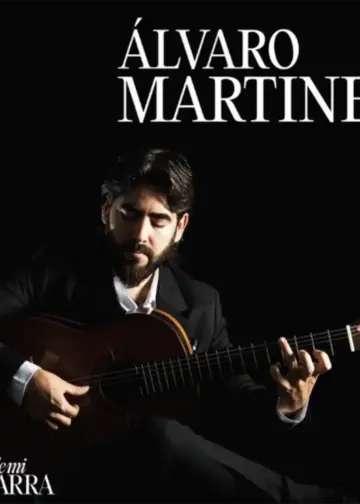
“I want people to hear
what I have to say as a guitarist and as a person”
By Manuel Moraga
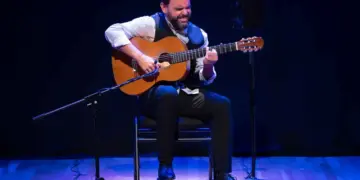
He doesn’t remember the first time he
picked up a guitar. His father, El Entri, says Jesús
was already playing at the age of four. Now another
maestro, Gerardo Núñez, has given him
the opportunity to make his first solo album. From Caño
Roto, and with guest collaborations such as Tomatito
and Sara Baras, Jesús de Rosaio presents “Sin
tanto”.
Your most important learning
zone…the home…
Mostly from my father. He’s the one who taught
me guitar, he showed me exercises, put my hands in the
right position to get sound out of the guitar, showed
me how to learn solos from recordings of Sabicas, Montoya,
Mario Escudero… Little by little he turned me into
a guitarist.
You’ve worked with
a lot of the big names: Yerbabuena, Canales, Sara Baras…
what do you think they see in your playing?
I couldn’t really say, but whenever they call
me to accompany dance I make an effort to play things
that are rhythmically comfortable and I make sure the
guitar variations are adaptable to the footwork. The
truth is, dancers always appreciate that. Also, I’ve
been playing for dance a long time and I’ve got
experience. I think what they hear is the rhythm I give
them, they feel comfortable with a foundation they can
grab onto. That’s what I try for, to make the
dancer feel at ease.
This is your first solo album.
Did you feel comfortable with the new responsibility
of having original work bearing your name?
In actual fact you’re always there backing up
the dancers and you realize you also need to feel fulfilled
as a guitarist and I needed to record because I had
the music thing on the back burner so to speak. It felt
a little strange. As I was recording I was already imagining
the recitals, the responsibility of playing alone on
a stage, but the people I’ve played for have also
given me the opportunity: whenever they called me to
play they would carve out a spot in the show where I
could play alone. I’m grateful because thanks
to them I’m now accustomed to playing alone.
“Maybe I’m
just watching my father or my little boy walking around
the house, I pick up the guitar and the notes start
to flow”
Your facet as composer is
very developed. You’ve composed for many works,
how do you manage it?
My modus operandi for composing is first I have a talk-over
with the person to see just what they need, and determine
whether the music has to adapt to the dance, or viceversa.
That’s how we tend to work. They also give me
a script and as I read it I’m imagining the musical
fragments and things begin to take shape. With respect
to my own compositions, I take a lot longer. There are
times when I draw a complete blank, but then suddenly
I get a flash, grab the guitar and start playing something.
Maybe I’m just watching my father or my little
boy walking around the house, I pick up the guitar and
the notes start to flow.
And then you develop it…
Exactly, I elaborate on it, add a bass, harmony, etc…
Until I get what I want.
How do you know that a piece
of 4, 5 or 6 minutes ends then and there? When do you
say “that’s it”? Is it hard to determine
that moment?
It’s not easy, not easy at all, because nearly
always I’m full of ideas. I don’t sit down
to create thinking of any specific duration. I just
develop the idea and the music carries me along, from
beginning to end. Most of all I’m concerned about
the piece having coherence. For example, if I play a
rondeña it has to have a beautiful introduction,
there has to be development in the bass tones (because
that’s where we lower the sixth and third strings),
I make sure there are good-sounding chords, senstive
melodies that touch people (that’s the nicest
part), that there’s a musical scale (and if it’s
a fast run, all the better), a nice tremolo, an ending…
In other words, I want people to feel there is a beginning
and an end.
As if you were telling a
story…
Exactly, it’s the same thing…like a conversation…
“As far as I’m
concerned, Sabicas was perfect”
The
record includes four dedications: Riqueni, Sabicas,
Manzanita and El Entri…
My father, you can imagine, he taught me everything.
When I was recording he liked the minera alot and I
said ”look Dad, listen to this and see if you
like it”…he started to cry. That moved me and
I decided to dedicate the piece to him because he deserves
it. Sabicas wasn’t admired for is bulerías.
But the truth is, he was very flamenco, in the way he
marked the ‘aire’, things like that… You
had to understand the era, he was the best of that era
beyond any doubt. Now they come along and say, “no,
but this, that and the other thing…”. There
are some people who are always looking for something
negative. I don’t know why it has to be that way
with Sabicas because as far as I’m concerned he
was perfect and his playing had tremendous ambience
and his bulería was great. I was fortunate enough
to record with Tomate (a real maestro who plays bulerías
to die for and with great feeling), and with Antonio
Carmona (who does the percussion) and I thought “I
have to dedicate this to Sabas so people can understand
what great feeling he had”.
Riqueni
He’s a very special case, I like him a lot. A
maestro. He’s a composer of this century and I
always expect new things from him, I find his work very
attractive. He has this powerful greatness. He makes
an impression on me whenever I listen to him, I can
see his sensitivity, a sort of fullness, a concern for
playing his instrument well and making it sound flamenco,
the love he has for the guitar and the desire to express
this to others. I like all his records, from beginning
to end. It’s a great honor for me to be able to
dedicate a piece from my record to him.
Then there’s Manzanita,
one of the flamenco artists who has most brought the
name of Caño Roto to the world.
We’re especially fond of Manzanita because he
and my father worked together at Los Canasteros when
Manolo Caracol was there. They had a great relationshiop
and were very close friends. He came to grandmother’s
house to live for a time, to eat and to play guitar
together. He was the biggest cut-up in the world and
in actual fact, was a great guitarist. Paco de Lucía
himself said he played very well and used to mention
him all the time. Really impressive. He had something
special with the guitar. I was in South America with
Canales when I got the news. I didn’t even know
he was ill. It came like a bucket of cold water, I began
to cry. I called my father and we spent two hours on
the phone crying. I picked up the guitar and a beautiful
phrase came out, like a mixture of pain and joy. Right
there in the hotel room I composed the rumba thinking
of him. He deserves it, not only because of what happened,
but because of the memories our family has of him. Hardly
anyone takes him for a serious guitarist, but Manzanita
would play rondeña, soleá, siguiriya…and
he was a real maestro, not a ‘rumbero’ or
a pop guitarist like some people think. He was a complete
guitarist with a great thumb, he made the guitar sound
really good, with ‘aire’ – for his
era he was one of the best.
They say he had a huge heart…
He was concerned about everyone else, even small children,
he always wanted them to be safe and well. l I remember
when we were touring in Málaga with Sara Baras
and he invited us to dinner at his house. As soon as
he saw me he started to cry, “you’re exactly
like your father, I really love your father. That touched
me, what a wonderful thing to be so real, with such
great capacity for affection! It’s very painful
that he left us so soon because he was a giant of an
artist and a person.
Why “Sin Tanto”?
Maybe people think it means “not so much of this”
or “not so much of the other thing”, but
it’s very simple. The first words spoken by my
little boy who’s now three and a half and is called
Jesús, were “sin tanto”. I was at
home playing the guitar and he started to say “sin-tan-to”.
Just like that, separating the syllables. So we made
him say it over and over, and my son gave the title
to my first recording, “Sin Tanto”.
On a normal day, how much
time do you devote to the guitar?
Some people kill themselves studying, but it’s
not my style. Maybe it ought to be, because you have
to study and for a guitarist it’s especially important,
but I’m always listening and I try to get certain
things. Mostly I love to listen. Maybe one day I spend
three or four hours, but I’m not very studious.
When I was a kid there was a time when I studied quite
a bit. Right now I have to get on the stick, because
being on stage alone and having such a big responsibility
requires brute technique, the people demand it. So I
really have to bone up and study, but with my father,
because he taught me the ropes.
“That such a big-name
guitarist should be concerned about helping out young
people, it’s a real honor”
Gerardo Núñez
produced your record. What’s it like working with
a producer who’s not only a guitarist, but a true
maestro?
Gerardo didn’t tamper much with the production,
I mean, he wasn’t saying ‘do this, do that’.
What he did do was give me advice, always excellent,
because Gerardo is one hell of a guitarist. But in actual
fact he gave me complete freedom. He had faith in me,
and in any case, was busy with his own concerts most
of the time. But we have a very good relationship, a
great friendship, and recording aside, he’s helped
me a great deal. I was also on his record “La
Nueva Escuela”. That such a big-name guitarist
should be concerned about helping out young people,
it’s a real honor. Bear in mind that when Gerardo
left his hometown to go to Madrid he found no support.
Paco was here, and Manolo Sanlúcar, well-known
guitarists with plenty of contacts, and they didn’t
lend a hand. That saddens me because you have to help
people, and that’s why I’m very grateful
to Gerardo Núñez. He opened many doors
for me. He deserved to have the same treatment.
There’s a fair amount
of footwork on the record.
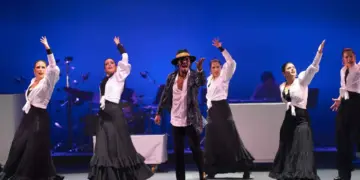
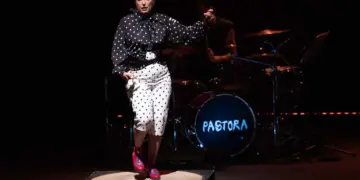
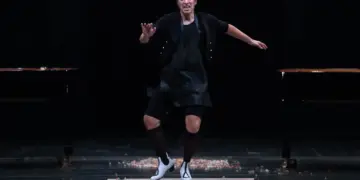
Yes, Sara Baras does the bulería por soleá
and Miguel Toleo does a bulería.
Do you like dance to sound?
Yes I do, for example, Miguel el Toleo has a personal
way with the rhythm and he inserts accents in the bulerías
that are very surprising, but very well-done, in just
the right place. And Sara Baras, well, she just had
to be there. In the beginning she helped me a lot and
gave me advice. I was with her group, seven or eight
years of my life playing for her. I wrote the music
for three or four of her works and we did tons of shows
throughout the world. But in the end, in actual fact,
I was a little surprised because she wasn’t everything
I expected. I’d always been helping out in everything,
but when it came down to money, there were some problems,
because the music of the last show is Manolo Sanlúcar’s
and there was a little…well, let’s just say
we didn’t see eye to eye. I left the group and
decided to try going it alone, I’d played plenty
for dancing and I needed to have my own compositions
and take stock: this rondeña for example, it
was going to be mine and I wasn’t going to give
it to anyone, just mine for recitals with my group,
and if everything goes well we’ll make it. You
have to go step by step. I know this is all very difficult,
but I want people to hear what I have to say as a guitarist
and as a person.
Is it true the people who
participate on “Sin Tanto” came asking to
join in, you didn’t have to ask them?
Yeah, that’s how it was. They’d call up,
“hey, I heard you’re making a record, give
me a call”. El Paquete, Bernardo Parrilla, el
Mario, el Miguel, el Lucky, Sara Baras… Tomate
also wanted to do something with us but didn’t
know how to approach the whole thing. I was in the studio
with my buddy Lucky Losada and I said to myself “why
not call Tomate to come and play in the bulería?”
I grabbed the phone and spoke to him and he agreed.
He’s really on the ball, and a great flamenco
fan…despite the huge career he’s made for himself,
he’s the biggest guitar-lover in the world. A
really nice bulería came out, and it was a real
pleasure playing with this man.
Was anything left out that
you would have included on this record?
You’re always left wondering about some things.
I’d have liked to play a soleá por bulería
with Diego Amador, because it’s very nice to have
piano on a guitar record, especially in Churry’s
hands, a real giant of a pianist. I mentioned it to
him, he agreed and was about to send me the music but
then Karonte called and also Gerardo and they said the
record had to be finished, because the truth is, I’d
spent hundreds of hours on it. In other words, I really
worked the thing over to get it just right.
“I want people to hear
what I have to say as a guitarist and as a person”
By Manuel Moraga
He doesn’t remember the first time he
picked up a guitar. His father, El Entri, says Jesús
was already playing at the age of four. Now another
maestro, Gerardo Núñez, has given him
the opportunity to make his first solo album. From Caño
Roto, and with guest collaborations such as Tomatito
and Sara Baras, Jesús de Rosaio presents “Sin
tanto”.
Your most important learning
zone…the home…
Mostly from my father. He’s the one who taught
me guitar, he showed me exercises, put my hands in the
right position to get sound out of the guitar, showed
me how to learn solos from recordings of Sabicas, Montoya,
Mario Escudero… Little by little he turned me into
a guitarist.
You’ve worked with
a lot of the big names: Yerbabuena, Canales, Sara Baras…
what do you think they see in your playing?
I couldn’t really say, but whenever they call
me to accompany dance I make an effort to play things
that are rhythmically comfortable and I make sure the
guitar variations are adaptable to the footwork. The
truth is, dancers always appreciate that. Also, I’ve
been playing for dance a long time and I’ve got
experience. I think what they hear is the rhythm I give
them, they feel comfortable with a foundation they can
grab onto. That’s what I try for, to make the
dancer feel at ease.
This is your first solo album.
Did you feel comfortable with the new responsibility
of having original work bearing your name?
In actual fact you’re always there backing up
the dancers and you realize you also need to feel fulfilled
as a guitarist and I needed to record because I had
the music thing on the back burner so to speak. It felt
a little strange. As I was recording I was already imagining
the recitals, the responsibility of playing alone on
a stage, but the people I’ve played for have also
given me the opportunity: whenever they called me to
play they would carve out a spot in the show where I
could play alone. I’m grateful because thanks
to them I’m now accustomed to playing alone.
“Maybe I’m
just watching my father or my little boy walking around
the house, I pick up the guitar and the notes start
to flow”
Your facet as composer is
very developed. You’ve composed for many works,
how do you manage it?
My modus operandi for composing is first I have a talk-over
with the person to see just what they need, and determine
whether the music has to adapt to the dance, or viceversa.
That’s how we tend to work. They also give me
a script and as I read it I’m imagining the musical
fragments and things begin to take shape. With respect
to my own compositions, I take a lot longer. There are
times when I draw a complete blank, but then suddenly
I get a flash, grab the guitar and start playing something.
Maybe I’m just watching my father or my little
boy walking around the house, I pick up the guitar and
the notes start to flow.
And then you develop it…
Exactly, I elaborate on it, add a bass, harmony, etc…
Until I get what I want.
How do you know that a piece
of 4, 5 or 6 minutes ends then and there? When do you
say “that’s it”? Is it hard to determine
that moment?
It’s not easy, not easy at all, because nearly
always I’m full of ideas. I don’t sit down
to create thinking of any specific duration. I just
develop the idea and the music carries me along, from
beginning to end. Most of all I’m concerned about
the piece having coherence. For example, if I play a
rondeña it has to have a beautiful introduction,
there has to be development in the bass tones (because
that’s where we lower the sixth and third strings),
I make sure there are good-sounding chords, senstive
melodies that touch people (that’s the nicest
part), that there’s a musical scale (and if it’s
a fast run, all the better), a nice tremolo, an ending…
In other words, I want people to feel there is a beginning
and an end.
As if you were telling a
story…
Exactly, it’s the same thing…like a conversation…
“As far as I’m
concerned, Sabicas was perfect”
The
record includes four dedications: Riqueni, Sabicas,
Manzanita and El Entri…
My father, you can imagine, he taught me everything.
When I was recording he liked the minera alot and I
said ”look Dad, listen to this and see if you
like it”…he started to cry. That moved me and
I decided to dedicate the piece to him because he deserves
it. Sabicas wasn’t admired for is bulerías.
But the truth is, he was very flamenco, in the way he
marked the ‘aire’, things like that… You
had to understand the era, he was the best of that era
beyond any doubt. Now they come along and say, “no,
but this, that and the other thing…”. There
are some people who are always looking for something
negative. I don’t know why it has to be that way
with Sabicas because as far as I’m concerned he
was perfect and his playing had tremendous ambience
and his bulería was great. I was fortunate enough
to record with Tomate (a real maestro who plays bulerías
to die for and with great feeling), and with Antonio
Carmona (who does the percussion) and I thought “I
have to dedicate this to Sabas so people can understand
what great feeling he had”.
Riqueni
He’s a very special case, I like him a lot. A
maestro. He’s a composer of this century and I
always expect new things from him, I find his work very
attractive. He has this powerful greatness. He makes
an impression on me whenever I listen to him, I can
see his sensitivity, a sort of fullness, a concern for
playing his instrument well and making it sound flamenco,
the love he has for the guitar and the desire to express
this to others. I like all his records, from beginning
to end. It’s a great honor for me to be able to
dedicate a piece from my record to him.
Then there’s Manzanita,
one of the flamenco artists who has most brought the
name of Caño Roto to the world.
We’re especially fond of Manzanita because he
and my father worked together at Los Canasteros when
Manolo Caracol was there. They had a great relationshiop
and were very close friends. He came to grandmother’s
house to live for a time, to eat and to play guitar
together. He was the biggest cut-up in the world and
in actual fact, was a great guitarist. Paco de Lucía
himself said he played very well and used to mention
him all the time. Really impressive. He had something
special with the guitar. I was in South America with
Canales when I got the news. I didn’t even know
he was ill. It came like a bucket of cold water, I began
to cry. I called my father and we spent two hours on
the phone crying. I picked up the guitar and a beautiful
phrase came out, like a mixture of pain and joy. Right
there in the hotel room I composed the rumba thinking
of him. He deserves it, not only because of what happened,
but because of the memories our family has of him. Hardly
anyone takes him for a serious guitarist, but Manzanita
would play rondeña, soleá, siguiriya…and
he was a real maestro, not a ‘rumbero’ or
a pop guitarist like some people think. He was a complete
guitarist with a great thumb, he made the guitar sound
really good, with ‘aire’ – for his
era he was one of the best.
They say he had a huge heart…
He was concerned about everyone else, even small children,
he always wanted them to be safe and well. l I remember
when we were touring in Málaga with Sara Baras
and he invited us to dinner at his house. As soon as
he saw me he started to cry, “you’re exactly
like your father, I really love your father. That touched
me, what a wonderful thing to be so real, with such
great capacity for affection! It’s very painful
that he left us so soon because he was a giant of an
artist and a person.
Why “Sin Tanto”?
Maybe people think it means “not so much of this”
or “not so much of the other thing”, but
it’s very simple. The first words spoken by my
little boy who’s now three and a half and is called
Jesús, were “sin tanto”. I was at
home playing the guitar and he started to say “sin-tan-to”.
Just like that, separating the syllables. So we made
him say it over and over, and my son gave the title
to my first recording, “Sin Tanto”.
On a normal day, how much
time do you devote to the guitar?
Some people kill themselves studying, but it’s
not my style. Maybe it ought to be, because you have
to study and for a guitarist it’s especially important,
but I’m always listening and I try to get certain
things. Mostly I love to listen. Maybe one day I spend
three or four hours, but I’m not very studious.
When I was a kid there was a time when I studied quite
a bit. Right now I have to get on the stick, because
being on stage alone and having such a big responsibility
requires brute technique, the people demand it. So I
really have to bone up and study, but with my father,
because he taught me the ropes.
“That such a big-name
guitarist should be concerned about helping out young
people, it’s a real honor”
Gerardo Núñez
produced your record. What’s it like working with
a producer who’s not only a guitarist, but a true
maestro?
Gerardo didn’t tamper much with the production,
I mean, he wasn’t saying ‘do this, do that’.
What he did do was give me advice, always excellent,
because Gerardo is one hell of a guitarist. But in actual
fact he gave me complete freedom. He had faith in me,
and in any case, was busy with his own concerts most
of the time. But we have a very good relationship, a
great friendship, and recording aside, he’s helped
me a great deal. I was also on his record “La
Nueva Escuela”. That such a big-name guitarist
should be concerned about helping out young people,
it’s a real honor. Bear in mind that when Gerardo
left his hometown to go to Madrid he found no support.
Paco was here, and Manolo Sanlúcar, well-known
guitarists with plenty of contacts, and they didn’t
lend a hand. That saddens me because you have to help
people, and that’s why I’m very grateful
to Gerardo Núñez. He opened many doors
for me. He deserved to have the same treatment.
There’s a fair amount
of footwork on the record.
Yes, Sara Baras does the bulería por soleá
and Miguel Toleo does a bulería.
Do you like dance to sound?
Yes I do, for example, Miguel el Toleo has a personal
way with the rhythm and he inserts accents in the bulerías
that are very surprising, but very well-done, in just
the right place. And Sara Baras, well, she just had
to be there. In the beginning she helped me a lot and
gave me advice. I was with her group, seven or eight
years of my life playing for her. I wrote the music
for three or four of her works and we did tons of shows
throughout the world. But in the end, in actual fact,
I was a little surprised because she wasn’t everything
I expected. I’d always been helping out in everything,
but when it came down to money, there were some problems,
because the music of the last show is Manolo Sanlúcar’s
and there was a little…well, let’s just say
we didn’t see eye to eye. I left the group and
decided to try going it alone, I’d played plenty
for dancing and I needed to have my own compositions
and take stock: this rondeña for example, it
was going to be mine and I wasn’t going to give
it to anyone, just mine for recitals with my group,
and if everything goes well we’ll make it. You
have to go step by step. I know this is all very difficult,
but I want people to hear what I have to say as a guitarist
and as a person.
Is it true the people who
participate on “Sin Tanto” came asking to
join in, you didn’t have to ask them?
Yeah, that’s how it was. They’d call up,
“hey, I heard you’re making a record, give
me a call”. El Paquete, Bernardo Parrilla, el
Mario, el Miguel, el Lucky, Sara Baras… Tomate
also wanted to do something with us but didn’t
know how to approach the whole thing. I was in the studio
with my buddy Lucky Losada and I said to myself “why
not call Tomate to come and play in the bulería?”
I grabbed the phone and spoke to him and he agreed.
He’s really on the ball, and a great flamenco
fan…despite the huge career he’s made for himself,
he’s the biggest guitar-lover in the world. A
really nice bulería came out, and it was a real
pleasure playing with this man.
Was anything left out that
you would have included on this record?
You’re always left wondering about some things.
I’d have liked to play a soleá por bulería
with Diego Amador, because it’s very nice to have
piano on a guitar record, especially in Churry’s
hands, a real giant of a pianist. I mentioned it to
him, he agreed and was about to send me the music but
then Karonte called and also Gerardo and they said the
record had to be finished, because the truth is, I’d
spent hundreds of hours on it. In other words, I really
worked the thing over to get it just right.
Utilizamos cookies para asegurar que damos la mejor experiencia al usuario y obtener estadísticas en nuestro sitio web. Si continúa utilizando este sitio asumiremos que está de acuerdo. Más info:


 The
The