Like a cocktail of the best aged rum
with mint leaves. That’s what Ginesa Ortega’s
new record tastes like. She looks radiant and
sounds self-assured. Her ideas are clear and her
head is perfectly furnished (the rest of the package
looks good too while we’re at it) and one
demand takes priority over all else: sincerity.
She demands it of others and of herself. The straightforward
sincere quality of “Flamenca” achieves
that pleasant combination of freshness and timelessness.
Each new piece of work
reflects a moment and an idea defended at each
point in time. This is your fourth recording.
How would you define your moment and what were
you trying for?
I tried to reflect my flamenco side, which I’ve
always had but there’s always been a constant
coming and going throughout my career. Right now
I’m at a point where I’m looking back,
because it’s always a good thing to glance
back over your shoulder to see where you’re
coming from.
Your career is fascinating.
You’ve worked with such diverse groups as
the Fura, Iberia, you did “El Amor Brujo”,
you sang for Billie Holliday, Serrat, Bob Marley…
That can’t be coincidence. What does Ginesa
Ortega have that she takes on so many different
kinds of projects?
I don’t think I’m the only one who’s
done things like that, but it’s true that
I’ve always been open to any sort of collaboration.
Perhaps what I have is versatility.
Is this your most personalized
work? The reason I ask is because your presence
is strongly felt on the record, aside from the
singing.
Yes, I spent a lot of time on this, lots of energy
and love, lots of everything. And yes, it’s
the most personalized thing I’ve done. You
might say it’s my favorite child.
“I wanted
to transmit sincerity, love and respect for flamenco”
Seven of the nine
pieces on the record are your own compositions,
including the verses.
I’ve been writing and composing for some
time. Ever since I made the first record –
although I say I’ve got four records, I
don’t actually count two others I did at
the beginning, “Luna Entre Mimbres”
and “Suspiro Gitano” which are out
of print – ever since then there’s
been material of my own, both in traditonal cante
as well as derivative flamenco pop.
And when you write
songs, do you start with the music and then write
the verse, or does the verse come first and then
you look for appropriate music?
It all goes together. Inspiration comes when it
comes, and then the melody comes to mind if I
have something that hasn’t been recorded,
because sometimes I think of a verse and adapt
it to taranto or soleá or siguiriya, and
then the music is traditional. But when I think
of some tangos or bulerías, then the rhythm
automatically comes with the melody and the verse.
“You have to
think in the lyrical sense to write flamenco verses
and be able to sing them”
There are some very
good verses, like the one about the madman you
do for taranta for example. When you write verses
for flamenco, does anything go? Is it enough to
rhyme or write some pretty poetry, or does a flamenco
verse have to have other characteristics?
For me, a flamenco verse has to have a flamenco
or gypsy heart and soul. You have to think in
the lyrical sense to write flamenco verses and
be able to sing them. Some of my peers do verses
with a more modern content, but I don’t
think they’re appropriate. To mention motorcycles
in a soleá for example, I just don’t
see it.
Many authors claim
the poetry is the fourth great facet of flamenco
along with cante, dance and guitar. That folk
wisdom which is able to express in just three
or four lines ideas that accomplished writers
can’t communicate in an entire book…
Yes, that’s true. Flamenco itself is pure
poetry, let’s not forget that. Then there’s
the day-in day-out routine of life, computers,
cars… When you sing it has to be have a more
lyrical sense.
You sing to Carmen
Amaya and Sabicas. Were you very moved by them?
Very much so. Both of them were unique, this is
no news. They’re important references for
everyone in flamenco.
“You have to take note of these cantes
and cultivate them because they form part of a
great treasure”
You’ve always
had an affinity for mining cante. On this record
you go back to those forms with taranto and taranta.
I really like them a lot. These are very profound
forms, there’s a bottomless pit of suffering,
emotion, passion, pain and everything involved
with flamenco. Even when it’s not Andalusian
cante you have to take note of these cantes and
cultivate them because they form part of a great
treasure.
On this recording the
cante isn’t hidden in the background if
we compare it to the typical CD of recent years.
I wanted to do something simple, I mean there’s
no mystery. For soleá, fandangos and cante
de Levante I got Pepe Habichuela: his guitar created
a very special ambience and there was no need
for anything more than his playing and a voice.
For the rest of the pieces I tried to treat them
lovingly without letting them be overdone. Perhaps
it doesn’t sound as modern as what they’re
doing nowadays, but the record is honest and sincere.
That’s what I wanted to transmit: sincerity,
love and respect for flamenco.
Oddly enough, the piece
with the most elaborate arrangement is the siguiriya:
there’s a violin, the voice of Guadiana…
I say “oddly” because it’s the
most traditional style (along with soleá)
of the whole record. Why did you introduce arrangements
precisely here?
Because I wanted to do siguiriya, but it was already
included on previous recordings and I didn’t
want to repeat the same thing. Besides, I saw
this siguiriya as very pure at the same time as
daring. I’ve always felt that flamenco cante
like siguiriya or soleá, it’s so
tragic you have to do something wierd, almost
Picasso-like. That’s why I decided to do
the accompaniment the way I did. Siguiriya all
by itself, with just voice and guitar, is already
sufficiently grand, but in my mind I saw myself
as in a state of total madness.
Is there some background
that connects you to Pepe Habichuela and Guadiana,
or did you choose them because you find them especially
moving?
I like them alot, both Pepe’s guitar-playing
for these forms, and Guadiana’s voice. The
quality of Guadiana’s voice ought to be
heard much more in flamenco because it’s
a very flamenco sound, very well-cured at the
same time as modern. He has that precise mix that
ought to attract large audiences. And Pepe is
the essence, he also has that blend of old and
new. His playing is like a cathedral. When he
plays soleá, that man with that guitar,
it sounds fantastic, brilliant.
“No one knows
you better than you yourself”
Earlier I commented
that there’s a lot of you in this record
besides the actual interpretations. We’ve
talked about composition, but you also handled
the graphic design and directed the production.
How do you manage all these different facets?
Like I say, this is practically a hand-made product
that comes out of tremendous effort and tenacity,
which is what means the most to me, the persistance,
the struggle, the hard work. As far as producing,
I actually controlled my previous records a bit,
but this was the whole thing and it was exhausting.
All the same, I might do it all over again because
no one knows you better than you yourself. A producer
can come along and suggest something to sell lots
of records, but he may not have the same kind
of soul as yours. That’s how it is with
me. I’m very self-taught, a free spirit.
I made sure to surround myself with professionals,
people who when they walk out of the studio, know
exactly what they’ve done.
Speaking of freedom,
I have to bring up “Dos Gardenias”
which is the freest piece of all. You build on
and on with continuous variations… Then there’s
the harmonica of Antonio Serrano which sounds
like music of seaports, and it all evolves with
no repetition. And in the end, nothing resolves,
on the contrary, the song remains open-ended,
in the air…
The arrangement of “Dos Gardenias”
was conceived as a very sentimental ballad, very
romantic. Antonio Serrano’s harmonica is
very important, very sensitive, and then it turns
into a sort of blues sound, which is how it just
came out on the spur of the moment.
“I dedicate this
work to the people who look at your eyes when
they speak, and your heart when they listen”…
Is lack of sincerity the worst thing that can
happen to you?
Yes. To me, and to everyone else. We’re
living in a society where everything is manipulated
in the back room and where people who look you
in the eye are to be cherished and heeded and
listened to. We all need a little more humanity
in this world and to learn how to understand each
other, to dialogue and let each one have his or
her place with dignity, learn more about our neighbors’
culture and remember that life is a continuous
learning experience and it’s the most beautiful
thing there is. We always waste so much time hurting
each other.
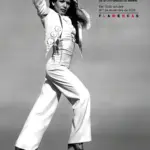
And what’s this
Jennifer López look? You’re a bombshell!
Don’t tell me! [laughter]. No, look, I wanted
to change my look because it was enough already
with the rasta dreadlocks, braids and all the
rest…I even died my hair green once. Now I’ve
decided to be a little more what I am, a Latin
woman of today’s world. I practice sports
and live healthfully. It’s a very serene
moment in my life.
That’s why I
said before, this is a very personal work, a different
moment in the life and work of Ginesa Ortega,
because from the first moment, the very first
glimpse, even the graphic concepts, you can tell
something different is going on. That’s
why I began the interview with that.
You can never really say it’s the best moment
of your life, but personally, deep down inside,
and I don’t mean to sound pompous, I see
myself as serene, without the impatience I had
when I was twenty, but with tremendous emotion
and dreams and the desire to communicate them,
to transmit good vibes and have them be perceived.
Interview
with
GINESA
ORTEGA
“I’ve decided to be more the real
me”
Manuel Moraga
Like a cocktail of the best aged rum
with mint leaves. That’s what Ginesa Ortega’s
new record tastes like. She looks radiant and
sounds self-assured. Her ideas are clear and her
head is perfectly furnished (the rest of the package
looks good too while we’re at it) and one
demand takes priority over all else: sincerity.
She demands it of others and of herself. The straightforward
sincere quality of “Flamenca” achieves
that pleasant combination of freshness and timelessness.
Each new piece of work
reflects a moment and an idea defended at each
point in time. This is your fourth recording.
How would you define your moment and what were
you trying for?
I tried to reflect my flamenco side, which I’ve
always had but there’s always been a constant
coming and going throughout my career. Right now
I’m at a point where I’m looking back,
because it’s always a good thing to glance
back over your shoulder to see where you’re
coming from.
Your career is fascinating.
You’ve worked with such diverse groups as
the Fura, Iberia, you did “El Amor Brujo”,
you sang for Billie Holliday, Serrat, Bob Marley…
That can’t be coincidence. What does Ginesa
Ortega have that she takes on so many different
kinds of projects?
I don’t think I’m the only one who’s
done things like that, but it’s true that
I’ve always been open to any sort of collaboration.
Perhaps what I have is versatility.
Is this your most personalized
work? The reason I ask is because your presence
is strongly felt on the record, aside from the
singing.
Yes, I spent a lot of time on this, lots of energy
and love, lots of everything. And yes, it’s
the most personalized thing I’ve done. You
might say it’s my favorite child.
“I wanted
to transmit sincerity, love and respect for flamenco”
Seven of the nine
pieces on the record are your own compositions,
including the verses.
I’ve been writing and composing for some
time. Ever since I made the first record –
although I say I’ve got four records, I
don’t actually count two others I did at
the beginning, “Luna Entre Mimbres”
and “Suspiro Gitano” which are out
of print – ever since then there’s
been material of my own, both in traditonal cante
as well as derivative flamenco pop.
And when you write
songs, do you start with the music and then write
the verse, or does the verse come first and then
you look for appropriate music?
It all goes together. Inspiration comes when it
comes, and then the melody comes to mind if I
have something that hasn’t been recorded,
because sometimes I think of a verse and adapt
it to taranto or soleá or siguiriya, and
then the music is traditional. But when I think
of some tangos or bulerías, then the rhythm
automatically comes with the melody and the verse.
“You have to
think in the lyrical sense to write flamenco verses
and be able to sing them”
There are some very
good verses, like the one about the madman you
do for taranta for example. When you write verses
for flamenco, does anything go? Is it enough to
rhyme or write some pretty poetry, or does a flamenco
verse have to have other characteristics?
For me, a flamenco verse has to have a flamenco
or gypsy heart and soul. You have to think in
the lyrical sense to write flamenco verses and
be able to sing them. Some of my peers do verses
with a more modern content, but I don’t
think they’re appropriate. To mention motorcycles
in a soleá for example, I just don’t
see it.
Many authors claim
the poetry is the fourth great facet of flamenco
along with cante, dance and guitar. That folk
wisdom which is able to express in just three
or four lines ideas that accomplished writers
can’t communicate in an entire book…
Yes, that’s true. Flamenco itself is pure
poetry, let’s not forget that. Then there’s
the day-in day-out routine of life, computers,
cars… When you sing it has to be have a more
lyrical sense.
You sing to Carmen
Amaya and Sabicas. Were you very moved by them?
Very much so. Both of them were unique, this is
no news. They’re important references for
everyone in flamenco.
“You have to take note of these cantes
and cultivate them because they form part of a
great treasure”
You’ve always
had an affinity for mining cante. On this record
you go back to those forms with taranto and taranta.
I really like them a lot. These are very profound
forms, there’s a bottomless pit of suffering,
emotion, passion, pain and everything involved
with flamenco. Even when it’s not Andalusian
cante you have to take note of these cantes and
cultivate them because they form part of a great
treasure.
On this recording the
cante isn’t hidden in the background if
we compare it to the typical CD of recent years.
I wanted to do something simple, I mean there’s
no mystery. For soleá, fandangos and cante
de Levante I got Pepe Habichuela: his guitar created
a very special ambience and there was no need
for anything more than his playing and a voice.
For the rest of the pieces I tried to treat them
lovingly without letting them be overdone. Perhaps
it doesn’t sound as modern as what they’re
doing nowadays, but the record is honest and sincere.
That’s what I wanted to transmit: sincerity,
love and respect for flamenco.
Oddly enough, the piece
with the most elaborate arrangement is the siguiriya:
there’s a violin, the voice of Guadiana…
I say “oddly” because it’s the
most traditional style (along with soleá)
of the whole record. Why did you introduce arrangements
precisely here?
Because I wanted to do siguiriya, but it was already
included on previous recordings and I didn’t
want to repeat the same thing. Besides, I saw
this siguiriya as very pure at the same time as
daring. I’ve always felt that flamenco cante
like siguiriya or soleá, it’s so
tragic you have to do something wierd, almost
Picasso-like. That’s why I decided to do
the accompaniment the way I did. Siguiriya all
by itself, with just voice and guitar, is already
sufficiently grand, but in my mind I saw myself
as in a state of total madness.
Is there some background
that connects you to Pepe Habichuela and Guadiana,
or did you choose them because you find them especially
moving?
I like them alot, both Pepe’s guitar-playing
for these forms, and Guadiana’s voice. The
quality of Guadiana’s voice ought to be
heard much more in flamenco because it’s
a very flamenco sound, very well-cured at the
same time as modern. He has that precise mix that
ought to attract large audiences. And Pepe is
the essence, he also has that blend of old and
new. His playing is like a cathedral. When he
plays soleá, that man with that guitar,
it sounds fantastic, brilliant.
“No one knows
you better than you yourself”
Earlier I commented
that there’s a lot of you in this record
besides the actual interpretations. We’ve
talked about composition, but you also handled
the graphic design and directed the production.
How do you manage all these different facets?
Like I say, this is practically a hand-made product
that comes out of tremendous effort and tenacity,
which is what means the most to me, the persistance,
the struggle, the hard work. As far as producing,
I actually controlled my previous records a bit,
but this was the whole thing and it was exhausting.
All the same, I might do it all over again because
no one knows you better than you yourself. A producer
can come along and suggest something to sell lots
of records, but he may not have the same kind
of soul as yours. That’s how it is with
me. I’m very self-taught, a free spirit.
I made sure to surround myself with professionals,
people who when they walk out of the studio, know
exactly what they’ve done.
Speaking of freedom,
I have to bring up “Dos Gardenias”
which is the freest piece of all. You build on
and on with continuous variations… Then there’s
the harmonica of Antonio Serrano which sounds
like music of seaports, and it all evolves with
no repetition. And in the end, nothing resolves,
on the contrary, the song remains open-ended,
in the air…
The arrangement of “Dos Gardenias”
was conceived as a very sentimental ballad, very
romantic. Antonio Serrano’s harmonica is
very important, very sensitive, and then it turns
into a sort of blues sound, which is how it just
came out on the spur of the moment.
“I dedicate this
work to the people who look at your eyes when
they speak, and your heart when they listen”…
Is lack of sincerity the worst thing that can
happen to you?
Yes. To me, and to everyone else. We’re
living in a society where everything is manipulated
in the back room and where people who look you
in the eye are to be cherished and heeded and
listened to. We all need a little more humanity
in this world and to learn how to understand each
other, to dialogue and let each one have his or
her place with dignity, learn more about our neighbors’
culture and remember that life is a continuous
learning experience and it’s the most beautiful
thing there is. We always waste so much time hurting
each other.
And what’s this
Jennifer López look? You’re a bombshell!
Don’t tell me! [laughter]. No, look, I wanted
to change my look because it was enough already
with the rasta dreadlocks, braids and all the
rest…I even died my hair green once. Now I’ve
decided to be a little more what I am, a Latin
woman of today’s world. I practice sports
and live healthfully. It’s a very serene
moment in my life.
That’s why I
said before, this is a very personal work, a different
moment in the life and work of Ginesa Ortega,
because from the first moment, the very first
glimpse, even the graphic concepts, you can tell
something different is going on. That’s
why I began the interview with that.
You can never really say it’s the best moment
of your life, but personally, deep down inside,
and I don’t mean to sound pompous, I see
myself as serene, without the impatience I had
when I was twenty, but with tremendous emotion
and dreams and the desire to communicate them,
to transmit good vibes and have them be perceived.
Descubre más desde Revista DeFlamenco.com
Suscríbete y recibe las últimas entradas en tu correo electrónico.
Utilizamos cookies para asegurar que damos la mejor experiencia al usuario y obtener estadísticas en nuestro sitio web. Si continúa utilizando este sitio asumiremos que está de acuerdo. Más info: