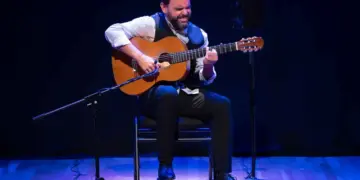
With over 300 record collaborations under his belt,
Enrique de Melchor (Marchena, 1950), son of the legendary
guitarist Melchor de Marchena, has just released his fourth
solo album. The title “Raíz Flamenca” [flamenco
roots], is a perfect reflection and declaration of the musician’s
principles, because the recording is a celebration of his
past with an eye to the future. Flamenco is within him since
birth, and his compositions exude an air of authenticity and
true-life experience.
What is the Plaza Ducal?
– It’s a plaza in Marchena where it’s more commonly
known as the Plaza Rivas, but the real name is Plaza Ducal.
It’s where all the gypsies grew up and where my father
was born. There used to be flamenco fiestas there, they would
build a fire in the middle and sing and dance all night. That’s
why I called the bulerías on my new record by that
name.
It is the plaza that’s on the cover
of the record?
– No, that the San Agustín church, I used to live
on a street very close by, and on one side is the school I
attended.
How long did you live in Marchena? What
memories do you have of those days?
– I grew up there until the age of thirteen. I return frequently,
to visit relative and friends. When I’m there I like
to take a walk around the old places of my childhood, it’s
really changed a lot.
Was your father living there back then?
– No, all us kids were there, but my father was always traveling.
Until I was twelve or thirteen we didn’t all come to
Madrid.
Did your father, the great Melchor de
Marchena, help you when you were learning to play guitar?
My father didn’t want me to be a guitarist. But I was
playing ever since I was small, and when my father went to
play at Los Canasteros with Caracol here in Madrid, I used
to come several days each month to see him. I loved the ambience
of that place. On one occasion I finally told my father I
didn’t want to go to school any more, that what I wanted
was to play the guitar.
There was a guitarist there in the tablao who played very
well, and he retired, El Nani, from Caño Roto, so he
told me to play a bit and said I had a great knack…we became
friends, hung out together and he began to teach me to play,
so I stayed on.
Why didn’t your father want you
to be a guitarist?
– It’s not that he didn’t want it, all parents
like their children to follow in their footsteps, but in those
days you couldn’t make a good living with the guitar,
or with flamenco in general…and he wanted a more stable
future for me; if I didn’t play guitar now, I’d
be in an office or a bank. That’s how it was back then,
no one ever dreamed flamenco would be so popular. Take into
account that artists were earning peanuts even if they were
lucky enough to be in a tablao – most of them had to
while away their lives waiting at roadside inns until four
or five in case some rich guy came and offered them something
to eat.
So are you Melchor de Marchena’s
main disciple? Are there other guitarists in the family who
continue the tradition?
– I’m his main disciple and heir. Yes, there’s
a nephew of mine who also plays guitar, he’s about 32
or 33, but the fact is, the world of guitar-playing is very
difficult.
Do you have any children?
– I have daughters, and I don’t like to see a woman
play guitar, it’s not being macho, I see a woman play
the piano or the violin and it’s looks fine, it’s
feminine, but playing a guitar, I just can’t handle
it. The only woman guitarist I’ve known is called Francisca,
she was at the table Café de Chinitas, and she played
very well, but then she got married and quit.
You’ve helped set a style of playing
guitar. Have you taught guitarists?
– Yes, I’ve taught a lot of people, I also gave many
guitar courses, given seminars and workshops…there are a
lot of people who follow my way of playing, like Oscar Luis
Herrero and Juan José Pantoja, lots of people.
You’ve also published several ‘methods’…
– That’s right, just last month I did one for France,
a teaching video which is also in sheet music, it’s
coming out in September.
The ‘falsetas’ you use when
you accompany have become a reference for many gutarists.
– A lot of them have followed my style of accompaniment,
just as many people have drawn from Paco de Lucía’s
approach to accompaniment, his falsetas. Because it’s
very different playing for singing and playing solo. The falsetas
for cante are better-defined, shorter.
You were playing with Paco de Lucía
for two years as second guitar, isn’t that so?
– Yes, it was just the two of us, at that time Paco wasn’t
so famous. We did a lot of tours abroad – France, Germany,
Japan… Later on my buddy Ramón de Algeciras joined
us. Paco did the first part alone, and then we did the second
half between the two of us.
There’s a piece on the record you
did with Paco, the fandangos “Viejos Tiempos”.
– Yes, that was from a time we bumped into each other at
the studio, he was recording and I said to him that I’d
really like him to participate, and it was fine with him.
And what was your relationship with Antonio
Mairena?
– I was a child when I met him and my father was playing
for him. Later on I played for a group with Sara Lezana, we
had to go to Barcelona for a job, and I knew my father was
recording with Mairena in the studio, so two hours before
catching the plane to Barcelona I went to the studio to hear
them both. My father asked Mairena if I could play something
for the record, and Antonio felt obliged to agree. He liked
it so much that before going to the airport, in two hours,
I made the record with him. When my father was older, in the
last festivals and concerts Mairena did, I played for him.
There was also another record in Seville, “Al calor
de mis recuerdos”, I did a lot of things with him.
What was it like a Los Canasteros?
– At that time Los Canasteros, it was like going to the Teatro
Real now. All the greatest artists passed through, many of
them in the ‘cuadro’, not even soloists.
Did young people go there to learn from
the guitarists who worked there?
– Yes, it was different back then, there was a lot of genuine
interest in classic flamenco, if I heard there was a certain
guitarist in a certain tablao, I’d go and have a drink
there to be able to listen to him. Now it’s more complicated,
now they go to the more fashionable places…there’s
a lot of talking and noise, and you can’t hear anything.
The tablaos now have nothing to do with
the ones there used to be…
– They’re different now, they concentrate more on offering
a dinner, they cater to tourists…and they close at half
past twelve. When I worked at Canasteros you finished at four
or five in the morning.
And now there are special schools where you can go, there
didn’t used to be, there’s the Flamenco Conservatory
in Córdoba, here in Madrid there’s Amor de Dios
with guitar, dance and cante teachers…everything.
Although you’re one of the foremost
guitar soloists, you’re more known for accompaniment,
perhaps because you’ve played for the best artists.
– Ninety percent of the flamenco artists who’ve recorded
over the last thirty years, I’ve played for or recorded
with them. I’m playing on about 300 recordings. It just
came out that way, I was never trying for it; I got type-cast
because all the singers think I’m easy to sing with.
Lebrijano, Mercé, Mairena, nothing to do with it, but
they all preferred me. Not that I’m complaining, but
in a certain sense it’s deprived me of my identity as
soloist, although it’s given me a name – in fifty
years when I’m no longer around and someone looks at
the records, they’ll see that Enrique de Melchor is
on 300 records with the best singers.
But which do you prefer, playing for singing,
or solo?
– I think a guitarist feels more fulfilled when he plays
solo, it’s what you like best, but in fact, in Spain,
it’s always been difficult to be a soloist, with the
exception of Paco de Lucía, very few people actually
live just from the guitar, because there are very few concerts,
although in the last few years the market is opening up. What’s
clear is that in the rest of the world flamenco guitar is
more appreciated than in Spain, there’s far more interest
in concert guitar.
In any case, I think that in Spain the guitar is more appreciated
than cante; if you look at the program of any festival there
tends to be some concert of some solo guitarist. Young people
enjoy the guitar much more than cante. It helps that guitar
recitals tend to make use of percussion, voices, sometimes
dance…
Really a lot of guitar records are being
recorded now, but of cante, almost none.
– Flamenco isn’t a big seller, the guitar does much
better.
– Antonio Mairena will always sell records, but you can’t
assume it amounts to much over the course of a year, it’s
very drip by drip, and it’s very hard to promote a soleá
or a siguiriya…cante is for a minority. But guitar is pleasing
to everyone, even if they’re not flamenco fans.
Are you a frustrated singer like so many
guitarists?
I like cante a lot, but I can’t sing at all.
Do you identify more with classic
flamenco, or what’s being done today?
It’s one and the same, there’s no such thing
as new flamenco, it’s a word they dreamt up, flamenco
is timeless, you can’t say Ketama is doing “new
flamenco”, they’re great artists, but it’s
not flamenco, the music they make is tinged with flamenco.
Flamenco is Paco de Lucía.
But Paco uses a lot of instruments, flutes
and such…
Paco de Lucía is always flamenco, it’s only
normal, we’re can’t live an era that existed a
hundred years ago, he still plays flamenco, he brought other
artists to our turf, it wasn’t the other way around.
José Mercé with his “Confí de fuá”,
that’s not flamenco, that’s just dumb, he’s
a flamenco singer and he recorded that to sell records and
so fine, but it’s not flamenco, it’s inspired
in flamenco, flamencofied. Yesterday I saw Falete on television,
a tremendous artist, doing flamenco the way it was in the
tablaos 30 years ago, like Bambino, Cañeta, just like
before, he hasn’t modernized.
Your record is called Raíz Flamenca,
just like the siguiriya that’s included, and José
Manuel Gamboa says in the booklet that it’s from your
beginnings.
They’re falsetas I recorded with many singers, normal
siguiriyas, but short, it’s not structured as a solo
composition, no one plays siguiriyas for a solo, it’s
too serious, but I think it’s a beautiful form, there’s
no voice so I do one falseta after another.
And the title “Raíz
Flamenca” identifies what’s on the record.
I come from flamenco roots, my father was a genius, an incredible
accompanist, no matter how much I advance, my roots are always
there.
You have four new pieces and seven from
previous recordings.
The new material was recorded for this record, over a year
ago now, but to make a completely new record, and seeing that
they wanted to make a collection of my previous work, I thought
it was the best thing, four new themes and the rest recuperated
from things I especially liked.
Did you pick out the eight pieces?
Yes, I chose what I thought best, especially based on whom
I was with, Paco de Lucía, Paco Rabal, Antonio Carmona,
Tino di Geraldo…a wealth of talent.
The first piece, the colombiana, “Pa’
que tú bailes” sounds very good.
I recorded that piece thirty years ago, on the first record
I ever made, “La guitarra flamenca de Enrique de Melchor”
with Philips, and Paco de Lucía’s father, I liked
it a lot and incorporated a flute, percussion and the voice
of Guadiana.
Is the world of flamenco still a closed
one?
No, it’s always been open, but the world of flamenco
is very small, I believe in mixing with any group, but trying
for something that sounds flamenco, to not lose our identity.
We have to play the way we play – flamenco – we have
nothing to do with other kinds of music, I defend my music.
With over 300 record collaborations under his belt,
Enrique de Melchor (Marchena, 1950), son of the legendary
guitarist Melchor de Marchena, has just released his fourth
solo album. The title “Raíz Flamenca” [flamenco
roots], is a perfect reflection and declaration of the musician’s
principles, because the recording is a celebration of his
past with an eye to the future. Flamenco is within him since
birth, and his compositions exude an air of authenticity and
true-life experience.
What is the Plaza Ducal?
– It’s a plaza in Marchena where it’s more commonly
known as the Plaza Rivas, but the real name is Plaza Ducal.
It’s where all the gypsies grew up and where my father
was born. There used to be flamenco fiestas there, they would
build a fire in the middle and sing and dance all night. That’s
why I called the bulerías on my new record by that
name.
It is the plaza that’s on the cover
of the record?
– No, that the San Agustín church, I used to live
on a street very close by, and on one side is the school I
attended.
How long did you live in Marchena? What
memories do you have of those days?
– I grew up there until the age of thirteen. I return frequently,
to visit relative and friends. When I’m there I like
to take a walk around the old places of my childhood, it’s
really changed a lot.
Was your father living there back then?
– No, all us kids were there, but my father was always traveling.
Until I was twelve or thirteen we didn’t all come to
Madrid.
Did your father, the great Melchor de
Marchena, help you when you were learning to play guitar?
My father didn’t want me to be a guitarist. But I was
playing ever since I was small, and when my father went to
play at Los Canasteros with Caracol here in Madrid, I used
to come several days each month to see him. I loved the ambience
of that place. On one occasion I finally told my father I
didn’t want to go to school any more, that what I wanted
was to play the guitar.
There was a guitarist there in the tablao who played very
well, and he retired, El Nani, from Caño Roto, so he
told me to play a bit and said I had a great knack…we became
friends, hung out together and he began to teach me to play,
so I stayed on.
Why didn’t your father want you
to be a guitarist?
– It’s not that he didn’t want it, all parents
like their children to follow in their footsteps, but in those
days you couldn’t make a good living with the guitar,
or with flamenco in general…and he wanted a more stable
future for me; if I didn’t play guitar now, I’d
be in an office or a bank. That’s how it was back then,
no one ever dreamed flamenco would be so popular. Take into
account that artists were earning peanuts even if they were
lucky enough to be in a tablao – most of them had to
while away their lives waiting at roadside inns until four
or five in case some rich guy came and offered them something
to eat.
So are you Melchor de Marchena’s
main disciple? Are there other guitarists in the family who
continue the tradition?
– I’m his main disciple and heir. Yes, there’s
a nephew of mine who also plays guitar, he’s about 32
or 33, but the fact is, the world of guitar-playing is very
difficult.
Do you have any children?
– I have daughters, and I don’t like to see a woman
play guitar, it’s not being macho, I see a woman play
the piano or the violin and it’s looks fine, it’s
feminine, but playing a guitar, I just can’t handle
it. The only woman guitarist I’ve known is called Francisca,
she was at the table Café de Chinitas, and she played
very well, but then she got married and quit.
You’ve helped set a style of playing
guitar. Have you taught guitarists?
– Yes, I’ve taught a lot of people, I also gave many
guitar courses, given seminars and workshops…there are a
lot of people who follow my way of playing, like Oscar Luis
Herrero and Juan José Pantoja, lots of people.
You’ve also published several ‘methods’…
– That’s right, just last month I did one for France,
a teaching video which is also in sheet music, it’s
coming out in September.
The ‘falsetas’ you use when
you accompany have become a reference for many gutarists.
– A lot of them have followed my style of accompaniment,
just as many people have drawn from Paco de Lucía’s
approach to accompaniment, his falsetas. Because it’s
very different playing for singing and playing solo. The falsetas
for cante are better-defined, shorter.
You were playing with Paco de Lucía
for two years as second guitar, isn’t that so?
– Yes, it was just the two of us, at that time Paco wasn’t
so famous. We did a lot of tours abroad – France, Germany,
Japan… Later on my buddy Ramón de Algeciras joined
us. Paco did the first part alone, and then we did the second
half between the two of us.
There’s a piece on the record you
did with Paco, the fandangos “Viejos Tiempos”.
– Yes, that was from a time we bumped into each other at
the studio, he was recording and I said to him that I’d
really like him to participate, and it was fine with him.
And what was your relationship with Antonio
Mairena?
– I was a child when I met him and my father was playing
for him. Later on I played for a group with Sara Lezana, we
had to go to Barcelona for a job, and I knew my father was
recording with Mairena in the studio, so two hours before
catching the plane to Barcelona I went to the studio to hear
them both. My father asked Mairena if I could play something
for the record, and Antonio felt obliged to agree. He liked
it so much that before going to the airport, in two hours,
I made the record with him. When my father was older, in the
last festivals and concerts Mairena did, I played for him.
There was also another record in Seville, “Al calor
de mis recuerdos”, I did a lot of things with him.
What was it like a Los Canasteros?
– At that time Los Canasteros, it was like going to the Teatro
Real now. All the greatest artists passed through, many of
them in the ‘cuadro’, not even soloists.
Did young people go there to learn from
the guitarists who worked there?
– Yes, it was different back then, there was a lot of genuine
interest in classic flamenco, if I heard there was a certain
guitarist in a certain tablao, I’d go and have a drink
there to be able to listen to him. Now it’s more complicated,
now they go to the more fashionable places…there’s
a lot of talking and noise, and you can’t hear anything.
The tablaos now have nothing to do with
the ones there used to be…
– They’re different now, they concentrate more on offering
a dinner, they cater to tourists…and they close at half
past twelve. When I worked at Canasteros you finished at four
or five in the morning.
And now there are special schools where you can go, there
didn’t used to be, there’s the Flamenco Conservatory
in Córdoba, here in Madrid there’s Amor de Dios
with guitar, dance and cante teachers…everything.
Although you’re one of the foremost
guitar soloists, you’re more known for accompaniment,
perhaps because you’ve played for the best artists.
– Ninety percent of the flamenco artists who’ve recorded
over the last thirty years, I’ve played for or recorded
with them. I’m playing on about 300 recordings. It just
came out that way, I was never trying for it; I got type-cast
because all the singers think I’m easy to sing with.
Lebrijano, Mercé, Mairena, nothing to do with it, but
they all preferred me. Not that I’m complaining, but
in a certain sense it’s deprived me of my identity as
soloist, although it’s given me a name – in fifty
years when I’m no longer around and someone looks at
the records, they’ll see that Enrique de Melchor is
on 300 records with the best singers.
But which do you prefer, playing for singing,
or solo?
– I think a guitarist feels more fulfilled when he plays
solo, it’s what you like best, but in fact, in Spain,
it’s always been difficult to be a soloist, with the
exception of Paco de Lucía, very few people actually
live just from the guitar, because there are very few concerts,
although in the last few years the market is opening up. What’s
clear is that in the rest of the world flamenco guitar is
more appreciated than in Spain, there’s far more interest
in concert guitar.
In any case, I think that in Spain the guitar is more appreciated
than cante; if you look at the program of any festival there
tends to be some concert of some solo guitarist. Young people
enjoy the guitar much more than cante. It helps that guitar
recitals tend to make use of percussion, voices, sometimes
dance…
Really a lot of guitar records are being
recorded now, but of cante, almost none.
– Flamenco isn’t a big seller, the guitar does much
better.
– Antonio Mairena will always sell records, but you can’t
assume it amounts to much over the course of a year, it’s
very drip by drip, and it’s very hard to promote a soleá
or a siguiriya…cante is for a minority. But guitar is pleasing
to everyone, even if they’re not flamenco fans.
Are you a frustrated singer like so many
guitarists?
I like cante a lot, but I can’t sing at all.
Do you identify more with classic
flamenco, or what’s being done today?
It’s one and the same, there’s no such thing
as new flamenco, it’s a word they dreamt up, flamenco
is timeless, you can’t say Ketama is doing “new
flamenco”, they’re great artists, but it’s
not flamenco, the music they make is tinged with flamenco.
Flamenco is Paco de Lucía.
But Paco uses a lot of instruments, flutes
and such…
Paco de Lucía is always flamenco, it’s only
normal, we’re can’t live an era that existed a
hundred years ago, he still plays flamenco, he brought other
artists to our turf, it wasn’t the other way around.
José Mercé with his “Confí de fuá”,
that’s not flamenco, that’s just dumb, he’s
a flamenco singer and he recorded that to sell records and
so fine, but it’s not flamenco, it’s inspired
in flamenco, flamencofied. Yesterday I saw Falete on television,
a tremendous artist, doing flamenco the way it was in the
tablaos 30 years ago, like Bambino, Cañeta, just like
before, he hasn’t modernized.
Your record is called Raíz Flamenca,
just like the siguiriya that’s included, and José
Manuel Gamboa says in the booklet that it’s from your
beginnings.
They’re falsetas I recorded with many singers, normal
siguiriyas, but short, it’s not structured as a solo
composition, no one plays siguiriyas for a solo, it’s
too serious, but I think it’s a beautiful form, there’s
no voice so I do one falseta after another.
And the title “Raíz
Flamenca” identifies what’s on the record.
I come from flamenco roots, my father was a genius, an incredible
accompanist, no matter how much I advance, my roots are always
there.
You have four new pieces and seven from
previous recordings.
The new material was recorded for this record, over a year
ago now, but to make a completely new record, and seeing that
they wanted to make a collection of my previous work, I thought
it was the best thing, four new themes and the rest recuperated
from things I especially liked.
Did you pick out the eight pieces?
Yes, I chose what I thought best, especially based on whom
I was with, Paco de Lucía, Paco Rabal, Antonio Carmona,
Tino di Geraldo…a wealth of talent.
The first piece, the colombiana, “Pa’
que tú bailes” sounds very good.
I recorded that piece thirty years ago, on the first record
I ever made, “La guitarra flamenca de Enrique de Melchor”
with Philips, and Paco de Lucía’s father, I liked
it a lot and incorporated a flute, percussion and the voice
of Guadiana.
Is the world of flamenco still a closed
one?
No, it’s always been open, but the world of flamenco
is very small, I believe in mixing with any group, but trying
for something that sounds flamenco, to not lose our identity.
We have to play the way we play – flamenco – we have
nothing to do with other kinds of music, I defend my music.
Utilizamos cookies para asegurar que damos la mejor experiencia al usuario y obtener estadísticas en nuestro sitio web. Si continúa utilizando este sitio asumiremos que está de acuerdo. Más info: