Miguel Ángel Pastor Santa María was
born in Cádiz in 1976. That same year Camarón
de la Isla’s song “Rosa María” shook
up flamenco fans by hitting the “Top Ten” list
of pop songs published by the Corte Inglés chain of
stores. At that time Antonio Mairena, the great maestro and
traditionalist, “intransigent” many would add,
was still deeply into the festival movement where not only
a light tango song like Rosa María, but also bulería
‘cuplé’ and popular ‘fandangos personales’
were off-limits, although many singers challenged the outmoded
prohibition. That same year saw the death of Agujeta viejo,
a singer who was the main heir to the cante of legendary Jerez
singer Manuel Torre, and was the father of today’s Manuel
Agujeta, as well the uncle of baby Ángel. A generational
torch was being passed, but in the home one of the most representative
families in the history of flamenco, this went unnoticed.
Ángel
grew up surrounded by the most traditional sort of cante,
and he learned the lesson well. But like all living things,
he was a product of his age and early on he felt the influence
of a new approach to flamenco in general, and cante in particular.
A few months ago the young man, now 29, made his first recording,
“Todos hablarán de mí” [‘They’re
all going to talk’], a prophetic title given his illustrious
lineage and taste for contemporary music.
Over glasses of manzanilla in the traditional surroundings
of the Perla de Cádiz flamenco club, the old slaughterhouse
where Enrique el Mellizo and Curro Durse once practiced their
trade, Ángel, a baby-faced young man about to turn
30, explained his modern take on flamenco in the shy and reticent
manner that characterizes him.
“Belonging to the Agujeta
family is a great source of pride”
Ángel, before we get started,
just how are you related to Manuel Agujetas?
Well, my father is Juan Pastor and my mother is María…Manuel
Agujetas is my father’s nephew because his mother is
my father’s sister…in other words, Manuel is my first
cousin.
Would you say you grew up with flamenco
cante?
Of course, ever since I was a little boy, that’s how
I learned, from the family, the get-togethers, I never listened
to records or anything, only my father, my cousins… I always
liked cante, ever since I was six or seven, it’s something…you
can’t explain it, but you can’t study it, these
people who go to cante classes to learn, they’ll never
get anything worthwhile that way.
Have you seen the interview with
your cousin Manuel that came out this week?
No, I haven’t…
I wanted to ask whether you agree
with some of the things he says…
[Laughter] Why? Does he say something weird? His usual comments
I guess, no? [More laughter].
Manuel has often said you have to
be illiterate to sing well. What do you think?
I’d almost agree with that, gypsy cante has to be savage
and anarchic, at least the basic cantes like ‘siriguilla’,
soleá…there’s no way to sit down and study
these things, and that’s why so few people can do it,
at least that’s how I see it.
Do you see Manuel often?
Very seldom… He’s always off someplace, Japan or whatever,
you really see him very little around here. I’m 29 now,
but I remember him since I was a child, when I was ten or
twelve he used to go off with my father to sing, and they’d
be gone three or four days.
What do you think of Manuel as a
singer?
Obviously I have only good things to say of him, he’s
my first cousin and he’s part of the history of flamenco
singing.
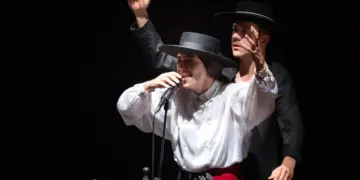
Angel Pastor
en la Peña La Perla
“Gypsy cante has to be savage
and anarchic…there’s no way to sit down and study
these things”
What does it represent for you
to be part of the Agujeta dynasty?
It’s very gratifying. A lot of people say I just sing
bulerías and haven’t done much with the cantes
of my family, but for me it’s a great source of pride,
you can imagine, not only because of Manuel, but also my father,
he’s really a good singer but not well-known in the
world of flamenco because he never went professional, always
private fiestas and things like that.
Do you go to Jerez much?
In actual fact I rarely go, but I’ve sung there a great
deal, with Capullo and a lot of other artists in Jerez.
Who plays for you on the record?
The guitarist is Juani de la Isla…he’s played a lot
with Cristina Hoyos, with lots of good people…Rancapino,
Luis de la Pica, Capullo… He always plays for me.
Aside from the unmistakable sound
of your family in the romance, the siguiriya, the soleá,
the fandangos and other traditional forms included on the
record, there’s also a certain similarity to El Barrio
in the more pop-oriented songs…a rather surprising combination…
Yes, of course, because my producer on the record who did
the arrangements is Barrio’s cousin, so the music sounds
similar, some of the pieces are in the “flamenkito”
vein, which is nice too, why not, it’s something different…
Where do you feel more at home,
singing “flamenkito”, or…. […he doesn’t
let me finish the question.]
What I like is genuine gitano cante, the thing is, what you
have to do to bring home the bacon and stay afloat is the
commercial material, but if I could choose freely I’d
always sing ‘siriguilla’, martinete, soleá,
fandangos…the cantes I learned when I was a child.
Are there other young people in
Cádiz who like those cantes?
No way, very few people are interested in them at all, that’s
how it is…here all they want is alegrías, a little
tanguillo, a little fandanguito, bulerías, malagueña…but
they’re not interested in serious cante here. Then they
say Jerez isn’t the birthplace, but I think it is, because
the way they sing ‘siriguillas’ in Jerez, no place
else in Spain they sing like that, any little gypsy kid picks
up a guitar and sings ‘siriguilla’, but they’re
unknown…I was in Santiago with a huge group of gypsies,
singing and dancing until 8 in the morning. But I like living
here in Cádiz, it’s a good life, easy-going,
I would never move to Madrid or anywhere else.
The arrangements on the record
make use of a lot of instruments. Did you perhaps feel that
was necessary to add interest?
That’s what people want to hear, instruments, the violin,
the piano, all that…people are tired of a guitar all by
itself, I don’t know, it’s not as stimulating
for the singer as it should be.
So
was that your idea, or the producer’s?
Diego Magallanes said to do it this way, he’s like a
brother for me, I wanted the record to be however he said,
and I’m delighted with the results, it’s a dream
come true.
Do you not feel the instruments
change the cante a little? How does that work anyhow? Each
musician with his score, and you sing along?
These guys are geniuses, I don’t know how they do it
but they always manage to follow me, whatever I do.
Have you sung for dancers?
Yes, I have…I sang for el Junco, for Juan and Pilar Ogalla,
for Sara Baras…a lot of people.. But I don’t like
it so much because the dancer takes all the credit.
Do you sing in peñas [private
flamenco clubs]?
Lots…and contests, but the people at the contests haven’t
got a clue, I don’t like contests and I won’t
be going to any more.
“People are tired of a guitar
all by itself…it’s not as stimulating for the singer
as it should be”
Getting back to what’s on
the CD, this “Yali, yali”…it has a certain Lebrija
sound…
Well, it’s a bulería ‘romance’…then
there’s the ‘siriguilla’ which has a fresh
modern sound…
I like timeless cante, not fresh,
not stale [he laughs]. Where can I hear cante in Cádiz?
Here in Cádiz? There are very few gypsies here, so
there’s hardly any cante…it’s something you
can tell as soon as the singer begins. But there are some
get-togethers, with friends, with El Barrio, us, my cousin
Joselito… Now with carnival, there’s a very strong
tradition surrounding carnival and a lot of people say that
takes away from flamenco in Cádiz, but carnival has
a life of its own, there’s just very little interest
in flamenco, very few peñas, it’s very limited…
What flamenco singers do you like?
Of the old-timers, a lot of them, each one had a distinctive
sound, they didn’t copy one another…now you hear five
young singers and they’re all the same. If you mean
people singing well in Cádiz today, you can count them
with the fingers of one hand…everything’s changed,
there isn’t anyone that makes you jump up and exclaim
“what a genius!”, unless you want to talk about
Juan Villar maybe, I don’t know… I like Manuel Agujetas,
but he sings very little any more…the way he sings, or other
greats like Terremoto, Tío Borrico, Juan Talega, Paquera
de Jerez… They were each one of a kind with their own personalities.
Do you like Camarón?
Well of course I like him. He triggered a revolution in flamenco,
I’ve never heard any gypsy say Camarón wasn’t
a great singer, number one in his style, Camarón was
some cantaor…
Where do you hope to go with your
cante?
This is my life, I hope to keep moving forward and work even
more. Now I’m involved in promotion for the record…I
signed three years with Paco Ortega and so far, so good, thank
God. This is very tough, it took a lot of hard work to get
this far, but in the end it all depends on the people, if
they don’t like you, you’ll never make it.
You’re young, but you come
out of a long tradition. What do you think about the direction
of flamenco nowadays?
I’ll tell you the truth, I don’t really like it,
because everything sounds pretty, the music, the lyrics, but…there’s
no cante to make you shout “ole!” On the other
hand, it’s good times for flamenco, everywhere you go
you hear Camarón and Capullo…in the old days you
never used to hear a twenty-year old listening to Terremoto
in his car.
Miguel Ángel Pastor Santa María was
born in Cádiz in 1976. That same year Camarón
de la Isla’s song “Rosa María” shook
up flamenco fans by hitting the “Top Ten” list
of pop songs published by the Corte Inglés chain of
stores. At that time Antonio Mairena, the great maestro and
traditionalist, “intransigent” many would add,
was still deeply into the festival movement where not only
a light tango song like Rosa María, but also bulería
‘cuplé’ and popular ‘fandangos personales’
were off-limits, although many singers challenged the outmoded
prohibition. That same year saw the death of Agujeta viejo,
a singer who was the main heir to the cante of legendary Jerez
singer Manuel Torre, and was the father of today’s Manuel
Agujeta, as well the uncle of baby Ángel. A generational
torch was being passed, but in the home one of the most representative
families in the history of flamenco, this went unnoticed.
Ángel
grew up surrounded by the most traditional sort of cante,
and he learned the lesson well. But like all living things,
he was a product of his age and early on he felt the influence
of a new approach to flamenco in general, and cante in particular.
A few months ago the young man, now 29, made his first recording,
“Todos hablarán de mí” [‘They’re
all going to talk’], a prophetic title given his illustrious
lineage and taste for contemporary music.
Over glasses of manzanilla in the traditional surroundings
of the Perla de Cádiz flamenco club, the old slaughterhouse
where Enrique el Mellizo and Curro Durse once practiced their
trade, Ángel, a baby-faced young man about to turn
30, explained his modern take on flamenco in the shy and reticent
manner that characterizes him.
“Belonging to the Agujeta
family is a great source of pride”
Ángel, before we get started,
just how are you related to Manuel Agujetas?
Well, my father is Juan Pastor and my mother is María…Manuel
Agujetas is my father’s nephew because his mother is
my father’s sister…in other words, Manuel is my first
cousin.
Would you say you grew up with flamenco
cante?
Of course, ever since I was a little boy, that’s how
I learned, from the family, the get-togethers, I never listened
to records or anything, only my father, my cousins… I always
liked cante, ever since I was six or seven, it’s something…you
can’t explain it, but you can’t study it, these
people who go to cante classes to learn, they’ll never
get anything worthwhile that way.
Have you seen the interview with
your cousin Manuel that came out this week?
No, I haven’t…
I wanted to ask whether you agree
with some of the things he says…
[Laughter] Why? Does he say something weird? His usual comments
I guess, no? [More laughter].
Manuel has often said you have to
be illiterate to sing well. What do you think?
I’d almost agree with that, gypsy cante has to be savage
and anarchic, at least the basic cantes like ‘siriguilla’,
soleá…there’s no way to sit down and study
these things, and that’s why so few people can do it,
at least that’s how I see it.
Do you see Manuel often?
Very seldom… He’s always off someplace, Japan or whatever,
you really see him very little around here. I’m 29 now,
but I remember him since I was a child, when I was ten or
twelve he used to go off with my father to sing, and they’d
be gone three or four days.
What do you think of Manuel as a
singer?
Obviously I have only good things to say of him, he’s
my first cousin and he’s part of the history of flamenco
singing.
Angel Pastor
en la Peña La Perla
“Gypsy cante has to be savage
and anarchic…there’s no way to sit down and study
these things”
What does it represent for you
to be part of the Agujeta dynasty?
It’s very gratifying. A lot of people say I just sing
bulerías and haven’t done much with the cantes
of my family, but for me it’s a great source of pride,
you can imagine, not only because of Manuel, but also my father,
he’s really a good singer but not well-known in the
world of flamenco because he never went professional, always
private fiestas and things like that.
Do you go to Jerez much?
In actual fact I rarely go, but I’ve sung there a great
deal, with Capullo and a lot of other artists in Jerez.
Who plays for you on the record?
The guitarist is Juani de la Isla…he’s played a lot
with Cristina Hoyos, with lots of good people…Rancapino,
Luis de la Pica, Capullo… He always plays for me.
Aside from the unmistakable sound
of your family in the romance, the siguiriya, the soleá,
the fandangos and other traditional forms included on the
record, there’s also a certain similarity to El Barrio
in the more pop-oriented songs…a rather surprising combination…
Yes, of course, because my producer on the record who did
the arrangements is Barrio’s cousin, so the music sounds
similar, some of the pieces are in the “flamenkito”
vein, which is nice too, why not, it’s something different…
Where do you feel more at home,
singing “flamenkito”, or…. […he doesn’t
let me finish the question.]
What I like is genuine gitano cante, the thing is, what you
have to do to bring home the bacon and stay afloat is the
commercial material, but if I could choose freely I’d
always sing ‘siriguilla’, martinete, soleá,
fandangos…the cantes I learned when I was a child.
Are there other young people in
Cádiz who like those cantes?
No way, very few people are interested in them at all, that’s
how it is…here all they want is alegrías, a little
tanguillo, a little fandanguito, bulerías, malagueña…but
they’re not interested in serious cante here. Then they
say Jerez isn’t the birthplace, but I think it is, because
the way they sing ‘siriguillas’ in Jerez, no place
else in Spain they sing like that, any little gypsy kid picks
up a guitar and sings ‘siriguilla’, but they’re
unknown…I was in Santiago with a huge group of gypsies,
singing and dancing until 8 in the morning. But I like living
here in Cádiz, it’s a good life, easy-going,
I would never move to Madrid or anywhere else.
The arrangements on the record
make use of a lot of instruments. Did you perhaps feel that
was necessary to add interest?
That’s what people want to hear, instruments, the violin,
the piano, all that…people are tired of a guitar all by
itself, I don’t know, it’s not as stimulating
for the singer as it should be.
So
was that your idea, or the producer’s?
Diego Magallanes said to do it this way, he’s like a
brother for me, I wanted the record to be however he said,
and I’m delighted with the results, it’s a dream
come true.
Do you not feel the instruments
change the cante a little? How does that work anyhow? Each
musician with his score, and you sing along?
These guys are geniuses, I don’t know how they do it
but they always manage to follow me, whatever I do.
Have you sung for dancers?
Yes, I have…I sang for el Junco, for Juan and Pilar Ogalla,
for Sara Baras…a lot of people.. But I don’t like
it so much because the dancer takes all the credit.
Do you sing in peñas [private
flamenco clubs]?
Lots…and contests, but the people at the contests haven’t
got a clue, I don’t like contests and I won’t
be going to any more.
“People are tired of a guitar
all by itself…it’s not as stimulating for the singer
as it should be”
Getting back to what’s on
the CD, this “Yali, yali”…it has a certain Lebrija
sound…
Well, it’s a bulería ‘romance’…then
there’s the ‘siriguilla’ which has a fresh
modern sound…
I like timeless cante, not fresh,
not stale [he laughs]. Where can I hear cante in Cádiz?
Here in Cádiz? There are very few gypsies here, so
there’s hardly any cante…it’s something you
can tell as soon as the singer begins. But there are some
get-togethers, with friends, with El Barrio, us, my cousin
Joselito… Now with carnival, there’s a very strong
tradition surrounding carnival and a lot of people say that
takes away from flamenco in Cádiz, but carnival has
a life of its own, there’s just very little interest
in flamenco, very few peñas, it’s very limited…
What flamenco singers do you like?
Of the old-timers, a lot of them, each one had a distinctive
sound, they didn’t copy one another…now you hear five
young singers and they’re all the same. If you mean
people singing well in Cádiz today, you can count them
with the fingers of one hand…everything’s changed,
there isn’t anyone that makes you jump up and exclaim
“what a genius!”, unless you want to talk about
Juan Villar maybe, I don’t know… I like Manuel Agujetas,
but he sings very little any more…the way he sings, or other
greats like Terremoto, Tío Borrico, Juan Talega, Paquera
de Jerez… They were each one of a kind with their own personalities.
Do you like Camarón?
Well of course I like him. He triggered a revolution in flamenco,
I’ve never heard any gypsy say Camarón wasn’t
a great singer, number one in his style, Camarón was
some cantaor…
Where do you hope to go with your
cante?
This is my life, I hope to keep moving forward and work even
more. Now I’m involved in promotion for the record…I
signed three years with Paco Ortega and so far, so good, thank
God. This is very tough, it took a lot of hard work to get
this far, but in the end it all depends on the people, if
they don’t like you, you’ll never make it.
You’re young, but you come
out of a long tradition. What do you think about the direction
of flamenco nowadays?
I’ll tell you the truth, I don’t really like it,
because everything sounds pretty, the music, the lyrics, but…there’s
no cante to make you shout “ole!” On the other
hand, it’s good times for flamenco, everywhere you go
you hear Camarón and Capullo…in the old days you
never used to hear a twenty-year old listening to Terremoto
in his car.
Utilizamos cookies para asegurar que damos la mejor experiencia al usuario y obtener estadísticas en nuestro sitio web. Si continúa utilizando este sitio asumiremos que está de acuerdo. Más info:

 Ángel
Ángel