Rutas del Flamenco - Andalucía
HOME - Deflamenco.com search
8th September 2008
Magazine Up-coming events Online shop Artist Places & People Courses
Updates News Interviews Show_reviews Cds_reviews Special_reports Articles Image_Galleries Videos


Interview with
JOSÉ MENESE

“A classic who never goes out of style.”

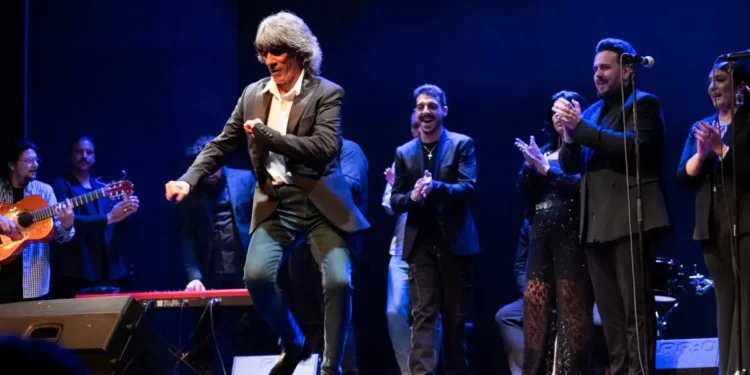
José Menese Scott, flamenco singer from La Puebla de Cazalla (Seville) is a survivor from the pre-Camaron era who did not get carried away by the winds of change and has managed to remain current with his strictly traditional cante. A follower of the Antonio Mairena school of gypsy-style cante, he himself is not gypsy but his singing always tends towards those basic forms of which he has vast knowledge, although he also likes to revive nearly forgotten cantes like the mariana, bamberas or peteneras among others. On the eve of his sixty-second birthday, the singer agreed to meet with Deflamenco at a cafeteria in Madrid, a city he’s lived in for the past 41 years.

José, you started out in flamenco in La Puebla...did you come to Madrid to work?
No, no…I came to learn, and I really had a hard time, like everything when you’re just starting out…I was lucky enough to be able to live with Francisco Moreno Galván so there was always something to eat.

Was he your sponsor? What was that like?
I don’t like that word very much…he was my creator. He wanted there to be a cantaor in his ideal image, he was a frustrated flamenco singer, he lived for flamenco. They told him about me in town...he’d come to film Laurence of Arabia in Seville, and on weekends he went to see me in La Puebla.

“My background was simple and straightforward, both as a person and as a cantaor…I met Antonio Mairena when I was 18 and he took me under his wing”

And you left La Puebla for Madrid on the back of a motorbike...
Yes, that was in ’62, I went to Madrid with Chumi Chúmez on the motorbike, what a bike, that went down in history…we left Córdoba at 7 in the morning and got there at 9 o’clock at night

Back then In La Puebla de Cazalla there must have been a lot of interest in flamenco, a lot of artists came from there...
Well….there were good, simple people…I think it’s all been lost, if anyone is still like that, god bless them. I started out at the Bar Central, just a kid, and they used to talk about cante, they sang some…that’s where José Menese came from.

Had you been born 15 years later, would you have gone in for flamenco?
I think so, the way I see things now, I think I’d have found flamenco in the long run because my voice is appropriate for flamenco…but if you said later on, in that case, no, things have gone too far astray.

Would you call yourself a Mairena follower?
My background was simple and straightforward, both as a person and as a cantaor…I met Antonio Mairena when I was 18 and he took me under his wing so to speak, he helped me, and he showed a wonderfully pure approach to flamenco singing. Everyone always wants to know what I think about fusion and I really don’t know what to say, I still haven’t seen any worthwhile fusion.

“You have to be full of life and vibrating all the time”

Is the school of Mairena still relevant, or is it history?
Mairena is there, he’s present, he has the largest body of recorded cante after Pastora, and the school is there, just like the Seville school of painting or bullfighting…that will always exist.

But young singers don’t go in for it...
Not at all, and let me tell you something, whoever doesn’t like what I have to say, too bad for them, let them do things any way they want. I became intimate with that moment in history: Perico, Juan Talega, Fernando Terremoto, Antonio Mairena…that’s the world that beckoned me and which I wanted, it’s what moved me.

José Menese is a classic…young singers ought to follow your example…
“Ought to”, you said it. But how can we make it happen? Today’s young people don’t look at cante for what it is, they see it as a way to make money…when I was young there was no such thing, you were happy to survive. Today’s youngsters make a fortune, they get rich in three days and that clouds their minds and atrophies the senses, I don’t think it’s good.

Does cante evolve? Does it even need to? Should young people go back to how it was before?
Let’s be honest, I’m not going to glaze anything over, there’s not one singer today I like, no one, not a one…I’ll say it eighteen-thousand times. In guitar yes, there has been evolution, but in cante there’s no one who interests me, I sit down and listen to them and they have nothing to say, it’s all empty…to sing, to bullfight, to paint…you have to be full of life and vibrating all the time…what I’m seeing these days is empty. Solo guitar has evolved in its own way, but how many guitarists are there in this country capable of filling a theater aside from Paco de Lucía? Why is everyone playing this game, how come we have to pretend everything’s great? I want something that sounds good, like Güito said about his legs, “taca-taca-taca”…but the body isn’t communicating anything.

The Reunión de Cante Jondo de La Puebla was created by you and Francisco Moreno Galván, one of the longest-running and prestigious festivals. How did that come about?
The Reunión de la Puebla de Cazalla was my idea, this is now acknowledged. Francisco was a terribly shy person, but even from before, in 1964 they were doing the Gazpacho de Morón, I remember I was summoned from military service to sing at the Gazpacho, and there was also the festival of Mairena del Alcor, but the first festival was the Potaje de Utrera. In 1967 a group of friends, writer Luis Rosales and others involved with us…I had the idea but Francisco was dead set against it, I had to convince him, and I told him how I wanted my town’s festival to be. The first year there was an incredible full moon…I said the festival had to begin punctually and everyone had to pay for their ticket except the mayor, the priest and a few others. It set precedents…two panels for a backdrop, traditional wicker chairs, strings of lanterns and that was it…

In those days every town had its festival, those were the golden years, but nowadays people are questioning that format. Do changes need to be made?
They’re right, let me tell you, festivals are doomed to disappear, they’ve fallen into cheap nonsense and vulgarity, I never had such a hard time in my life as this year in my town, all they care about is who draws a biggest crowd or makes the festival look more important and last longer…and all that can only hurt the art, because it becomes monotonous, everyone sings more or less the same thing, audiences get bored. I would make changes, put two good singers, one good dancer, two good guitarists and that’s it, 3 or 4 hours.

“Festivals are doomed to disappear, they’ve fallen into cheap nonsense and vulgarity” ”

Does flamenco come off better in theaters?
That’s a question that makes no sense, when you’re in the right state of mind you sing well in a thatched hut if necessary.

Yeah, but I mean for audiences as well...
I’ve done three consecutive days in the Albéniz theater with three sell-outs, just two guitarists and two palmeros. The other day in the Sabatini gardens there were no tickets left. A lot of different things have been done, flamenco too of course, but traditional cante done according to the traditional formula has a lot to do with it…and how well it’s organized, more than the physical aspect of the venue. Like Teresa Vico at the Albéniz.

You were one of the first flamenco singers to incorporate poetry in your verses.
Not poetry…one poet, Francisco Moreno Galván.

Is that difficult?
No, not at all…as I said before, Francisco Moreno wanted a singer trained to his liking and he spoke about our people and the traditions….that’s how it all started, Francisco Moreno Galván against the serfdom of the era.

Was singing Moreno Galván’s verses with social content helpful, or did that make things more difficult?
To tell the truth, throughout my career the fact of having been militant in the communist party and singing Francisco Moreno Galván’s verses – the best popular poet in history – had us pigeon-holed immediately, but instead of getting discouraged, it made me more defiant, and here I am, not even a third world war can do me in. They’ve accused me of everything…get this, on a stage in Morón one night when the governor of Seville was in the first row and roaring drunk, I told him to shut his trap.

But did it help you in some way?
No, it made things harder in those days and now as well.

Looking over your background it seems you’ve won all the prizes.
I’d rather not talk about that.

How did you manage to get all the important ones, and so early on…it seems like a long time ago…
It’s funny, I’m the only singer who won twice in Jerez, which is really something because you know how they are in Jerez, and they gave me the prize twice.

The Premio Príncipe de Asturias that was given to Paco...do you think it’s a prize for all flamenco as Paco says?
I think he deserved it in every way, I’ve always been a great admirer of Paco’s. We all know flamenco has been mistreated, we’ve been exploited and things still don’t work the way they should, nor are they going to work right for a long time. What he says, about for all flamenco, is an act of honesty on his part and it fills me with joy. Paco and I are good friends, no matter how important he has become, and he got his rightful place.

Were you friends with Camarón?
Me? With everyone.

Did you like Camarón’s singing?
It’s not that I liked it…it stood my hairs on end…but not everything of course…

What about what’s come since Camarón?
It DOES NOT interest me in the LEAST…you can put that in caps, it has no interest for me, I loved Camarón and we were good friends.

The show “A mis soledades voy, de mis soledades vengo”. How did that come about? I think they’re going to make a DVD of it, aren’t they?
It’s a long story, I’m very fond of that show, in the Bienal it went over very well, you have to try different things. People send me a lot of things, and among them, the year of Calderón de la Barca, they sent me a portrait of his, and a poem by Andrés Amorós. When I read that stuff I told my wife it would be great to sing it. I put the idea to a friend and together we went to work on it. We debuted with it in Almagro (Ciudad Read) in the beautiful gothic Convent of San Francisco…after that it started taking shape and we added elements, we had to get a girl singer, a girl dancer, two palmeros for certain things…something was still missing though, the orchestral arrangements, so we got Amargós, he’s the most appropriate choice, the most flamenco.


Throughout your career you were accompanied at first by Melchor de Marchena, later, for a long time, including recordings, by Enrique de Melchor. Who accompanies you now?
There’s a young guy in Seville, from San José de la Rinconada, called Antonio Carrión, who accompanies very well, he’s really hot and sounds very flamenco. Enrique de Melchor suddenly decided to pursue a solo career, it’s very complicated. But he still plays for me sometimes, he’s not very out-going, he finishes playing and heads for the door.

In a concert of yours of classic flamenco, what can we expect to see?
I never like to repeat myself, my character won’t permit it, I try to change things one way or another, and I think I’ve managed it, I make up cantes, revive forgotten or lost ones, I invent myself and change…never boring, no matter what.

“I never like to repeat myself, my character won’t permit it”

I was going to ask if you think flamenco is going through good times, but instead I’ll ask if José Menese is…
A while back things started going my way, there’s been change and that’s important…as Chacón said, it’s all voice and more voice, once you have that, the rest comes easy, and fortunately my voice is in good shape.

MAS INFORMACIÓN:

Review of the Reunión de Cante Jondo de la Puebla de Cazalla, 2004
Review of the Reunión de Cante Jondo de la Puebla de Cazalla 2003
Review of “De mis soledades voy, de mis soledades vengo” from the Bienal 2004
Interview with Antonio Carrión


Photos: Rafael Manjavacas y Estela Zatania
Text . Rafael Manjavacas Lara
rmanjava@deflamenco.com

Related product:

José Menese
'21 cantes'
José Menese & Enrique de Melchor.
'En Directo en El Albéniz'

Jose Menese
'A Francisco'

José Menese
'La Puerta Ronda'

 
Store in Madrid - Contact - Advertising - Subscribe
deflamenco en tu email
pago seguro. Tienda on-line flamenco
© 2003 Tintes Flamencos S. L. Todos los derechos reservados - CIF - B83546655.
Included in the Official Registry of mail-order businesses (NEVA) 2003/0337/13/28/4/V
Design by Krama, Madrid